The Statistical Corrector: Design Choices at p3
UPDATED 2026-09-29: additional figures and citation
Abstract
In these sessions the statistical corrector (SC) direction predictor is specified and implemented. At the end of these sessions the SC was verified at the unit level.
PA sessions 56 and 57 created the SC planning documents, PA sessions 58 and 59 implemented the RTL and testing. Under 58/59, tasks BP-075 to BP-079 were executed to create the RTL.
During SC implementation, the TAGE design elaboration was impacted. BP-080 was
executed to quantify the problems for repair in a follow on session. The main
problems were in TAGE confidence indicator flags, tage_high/medium/weak_conf.
BP-080 gathered data for the eventual fix in BP-081. Those repairs are complete
in the current repo RTL. Discussion of the repairs to TAGE will be in the next
article.
The SC design closed in this range as unit complete. Technical debt (TD#93) was recorded for performance analysis of the SC.
This article is a departure from the normal subject matter. These sessions followed the expected specification and execution sequence, and the SC work itself required no change to the methodology. The one process finding concerns package edits made during planning. They were not compiled, and one of them broke TAGE elaboration. The break was found by the standard methods and repaired in a later session.
Notwithstanding the large body of literature available describing statistical correctors, I will use some of this space to describe the Pacino statistical corrector in detail. There is also a non-exhaustive comparison of the Pacino design choices to the limited number of public designs.
The statistical corrector in Pacino
The statistical corrector (SC) is a tagless direction predictor used to assess predictions from TAGE and determine the likely correctness of the TAGE prediction.
The core mechanism in the Pacino SC is a GEHL-style [1] perceptron constructed from 5 tables (ST0-ST4) containing signed 6 bit counters. Three of the tables are indexed by varying length hashes of the direction history and PC, table 0 is unhashed. ST4 is a BrIMLI table indexed by a hash of the current loop’s iteration count.
The indexed counters read from the SC tables are combined to form a signed value. The sign of this value is the SC prediction, positive equals taken. The magnitude of this value is the SC confidence.
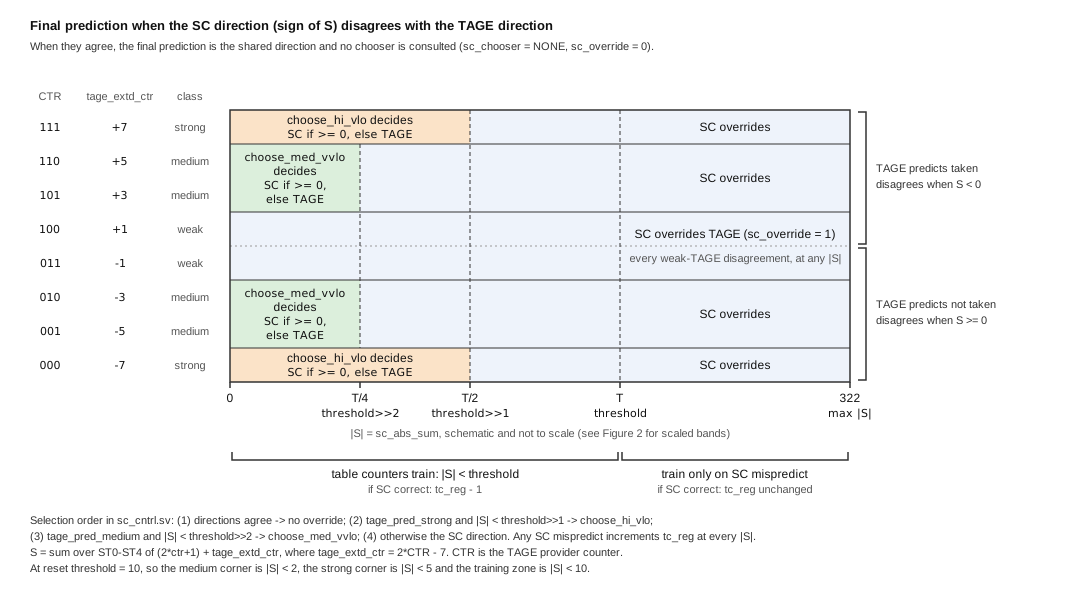
With two exceptions, the SC will override a TAGE prediction when SC and TAGE directions differ. The exceptions, and the two chooser counters that decide them, follow the chooser of TAGE-SC-L [7]. The exceptions are:
- TAGE strong, SC weak.
- The TAGE provider counter is saturated (strong) and the SC magnitude is
below half the threshold. The SC overrides only if the
choose_hi_vlocounter is non-negative. Otherwise the TAGE prediction stands.
- The TAGE provider counter is saturated (strong) and the SC magnitude is
below half the threshold. The SC overrides only if the
- TAGE medium, SC very weak.
- The TAGE provider counter is one or two steps from saturation (medium)
and the SC magnitude is below one quarter of the threshold. The SC
overrides only if the
choose_med_vvlocounter is non-negative. Otherwise the TAGE prediction stands.
- The TAGE provider counter is one or two steps from saturation (medium)
and the SC magnitude is below one quarter of the threshold. The SC
overrides only if the
Simplified explanation of the Pacino SC operation
The SC services two kinds of requests. A prediction request reads the SC tables and produces a prediction. An update request, issued when a branch resolves, trains the tables and the threshold logic. Only an update request modifies SC state.
There is one nuance in this process. During a prediction request the data needed by a subsequent update is returned along with the prediction in the prediction meta data. By doing this read/modify/writes of the SC state are not required. This improves the throughput of updates.
Prediction request
On a prediction request the SC reads one signed 6 bit counter from each of the
five tables. Each counter contributes 2*ctr+1 to the sum, a value between -63
and +63. The TAGE prediction meta data includes the provider counter (CTR) used
in the TAGE prediction. The 3 bit TAGE CTR is rescaled to a signed value
between -7 and +7, tage_extd_ctr = 2*CTR - 7, and added to the five table
contributions. This produces the sum S. The sign of S is the SC prediction,
sc_lcl_pred_tkn. The magnitude of S, |S|, is the SC’s confidence in that
prediction.
The SC’s confidence is used only when the SC prediction differs from the TAGE
prediction. If the TAGE and SC direction predictions are the same there is
nothing to override. When they differ, the result depends on the TAGE
confidence class, decoded from the TAGE CTR, and on |S| relative to the
threshold register.
- TAGE strong (
tage_pred_strong, CTR 000 or 111) and|S|less than one half ofthreshold: the strong-TAGE chooser,choose_hi_vlo, decides. The SC prediction is used ifchoose_hi_vlois non-negative, otherwise the TAGE prediction stands. - TAGE medium (
tage_pred_medium, CTR 001, 010, 101 or 110) and|S|less than one quarter ofthreshold: the medium-TAGE chooser,choose_med_vvlo, decides in the same way. - All other disagreements, including every disagreement where TAGE is weak (CTR 011 or 100): the SC prediction overrides the TAGE prediction.
A strong TAGE prediction is therefore overridden whenever the SC disagrees with
|S| at or above one half of threshold.
Figure 1 shows the same rule as a map. Each row is a TAGE provider counter
value and the horizontal axis is |S|. The map applies only when the SC and
TAGE directions differ. A chooser is consulted only in the two shaded corners.
Everywhere else the SC direction is final.
FIG 1: SC Override and Chooser Selection - Claude
The final prediction, sc_pred_tkn, is returned with the meta data needed for
the update: the five table indices, the five raw counter values, S, |S|,
the TAGE prediction, and which chooser, if any, was consulted.
There are four registers in the threshold logic.
| Common Name | RTL name | Width | Purpose |
|---|---|---|---|
| threshold register | threshold |
10 bit unsigned | marks the boundary between high and low SC confidence |
| threshold adaptation counter | tc_reg |
7 bit signed | determines when to modify threshold |
| strong-TAGE chooser | choose_hi_vlo |
6 bit signed | picks SC or TAGE when the TAGE prediction is strong and SC is weak |
| medium-TAGE chooser | choose_med_vvlo |
6 bit signed | picks SC or TAGE when the TAGE prediction is medium and SC is very weak |
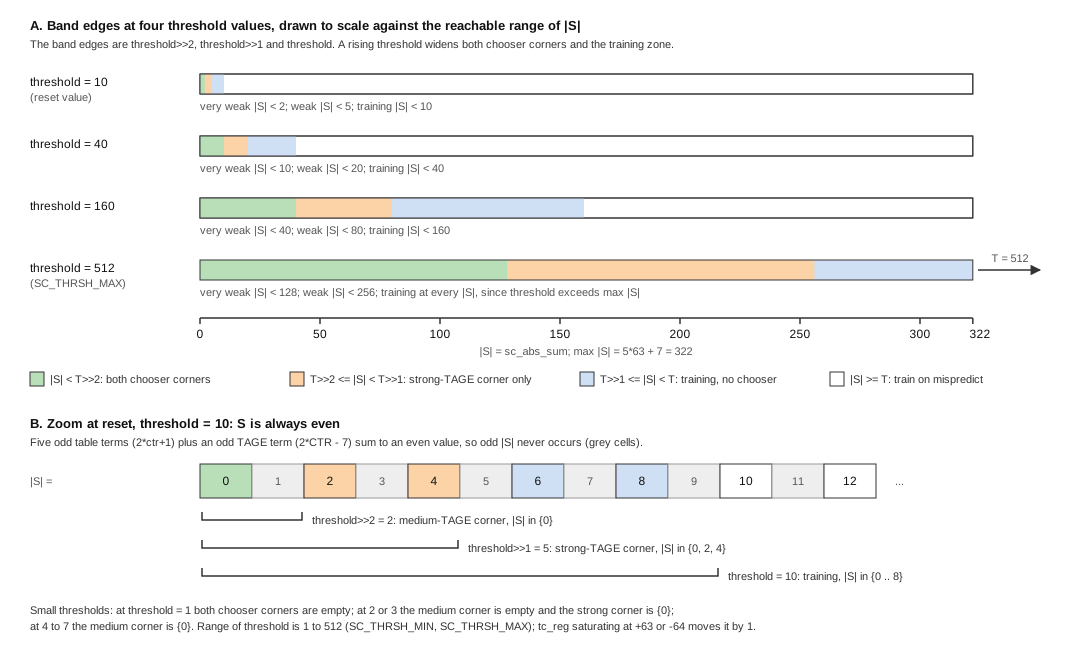
In Pacino an SC prediction is considered weak when |S| is less than one half
of threshold. An SC prediction is considered very weak when |S| is less
than one quarter of threshold. The fractions are fixed in the comparison
logic. The band boundaries move with the value held in threshold.
Figure 2 draws the bands to scale. The five table terms, 2*ctr+1, and the
TAGE term, 2*CTR - 7, are all odd, and there are six of them, so S is
always even. At the reset value of 10 the medium-TAGE corner therefore admits
only |S| = 0, the strong-TAGE corner admits 0, 2 and 4, and the training gate
admits 0 through 8. The corners widen in proportion as threshold rises. At a
threshold below 4 the medium-TAGE corner is empty, and at 512 the training
gate covers every achievable |S|.
FIG 2: SC Confidence Bands - Claude
The choose_hi_vlo register learns which of TAGE or SC is more often correct
when a strong TAGE prediction is contradicted by a weak SC prediction.
The choose_med_vvlo register learns which of TAGE or SC is more often correct
when a medium confidence TAGE prediction is contradicted by a very weak SC
prediction.
Update request
An update request returns the prediction meta data with the resolved
direction, resolved_taken. Up to two update requests are accepted per cycle,
one per prediction slot.
Table counters. The counters are trained when the SC prediction was
incorrect (sc_lcl_pred_tkn != resolved_taken) or when |S| is less than
threshold. When training is enabled, each of the five captured counters
moves one step toward the resolved direction, saturating at -32 and +31, and is
written back at its captured index. The tables are not read during the update.
Each slot writes its own table RAMs.
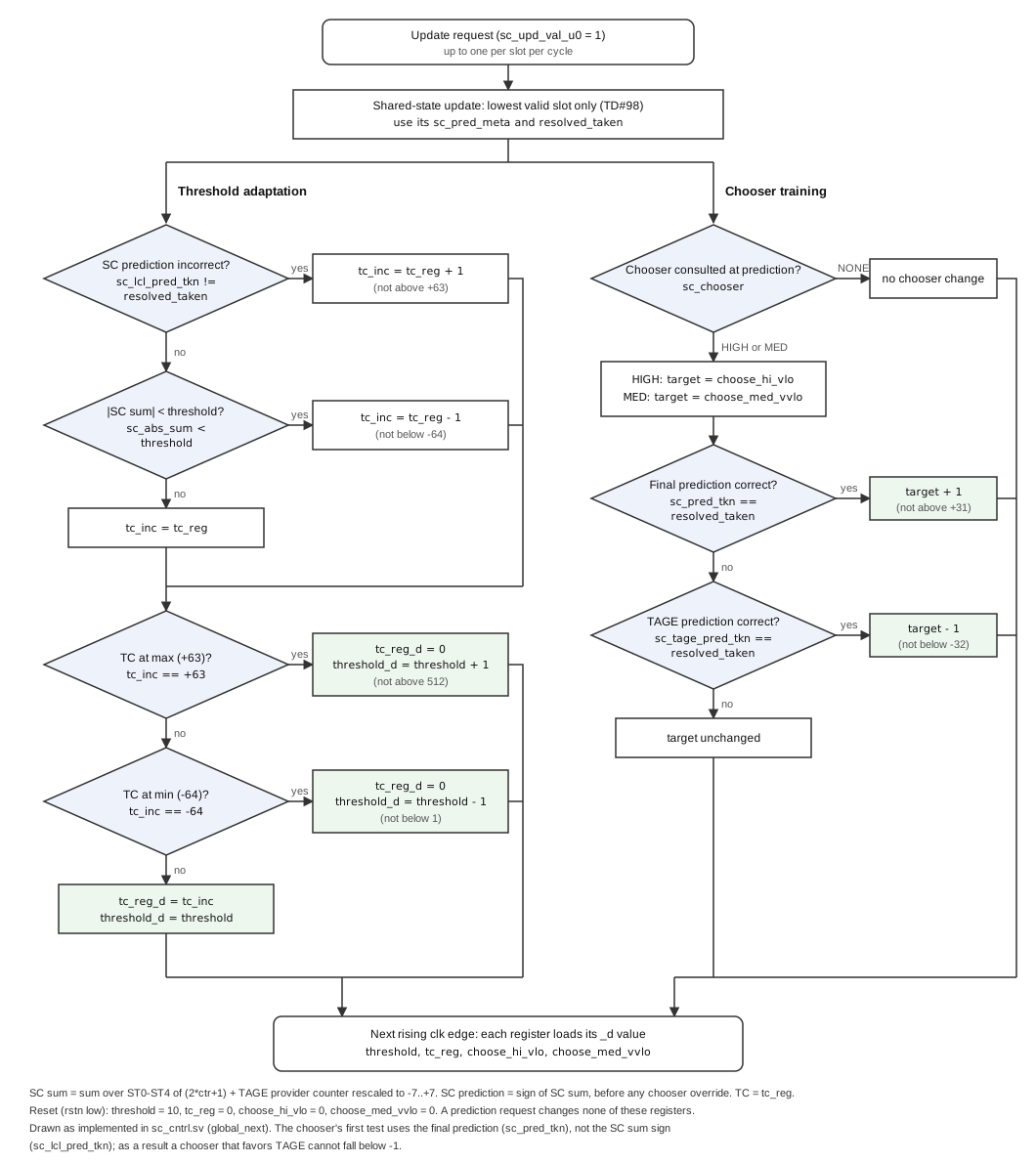
Threshold registers. threshold, tc_reg and the two choosers are single
registers shared by both slots. When both slots present an update in the same
cycle, only the lowest-indexed valid slot changes them (TD #98).
tc_reg is updated on every update request.
tc_regis incremented if the SC prediction was incorrect (sc_pred_meta.sc_lcl_pred_tkn != sc_upd_inp_u0.resolved_taken).- Otherwise
tc_regis decremented if|S|is less thanthreshold. -
Otherwise
tc_regis unchanged. - If
tc_regreaches +63,tc_regis cleared andthresholdis incremented, up to 512. - If
tc_regreaches -64,tc_regis cleared andthresholdis decremented, down to 1.
threshold resets to 10 and tc_reg resets to 0. A sustained excess of SC
mispredictions raises threshold, which widens the training margin and both
chooser bands. A sustained excess of correct, low-confidence SC predictions
lowers it.
A chooser is updated only when it was consulted for the prediction. It is incremented if the final prediction was correct, and decremented if the final prediction was incorrect and the TAGE prediction was correct. Both choosers saturate at -32 and +31 and reset to 0.
A consulted chooser always sees a disagreement, so exactly one of the SC and
TAGE predictions is correct. Figure 3 tabulates the four cases. The first
test compares the final prediction, sc_pred_tkn, with the resolved
direction. A chooser at -1 selects TAGE, so the decrement case, a wrong final
prediction with a correct TAGE prediction, cannot occur. The values -32 to -2
are not reachable from reset.
FIG 3: SC Chooser Update - Claude
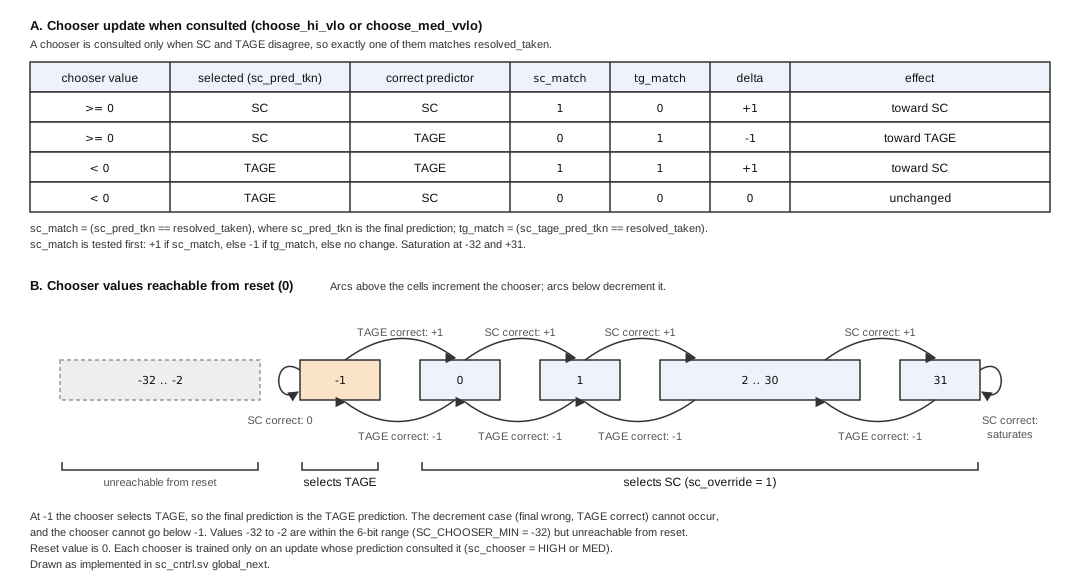
Figure 4 shows the update of the four threshold registers for one update request.
FIG 4: SC Threshold and Chooser Update - Claude
Effectiveness of statistical correctors
In general the literature agrees that statistical correctors improve prediction accuracy. There is mixed data on the effectiveness, and there are few public disclosures of commercial designs implementing an SC, although there are hints in patent filings and whitepapers of unshipped RISC-V machines.
I mentioned that the utility of the SC will be analyzed in the future, TD #93
records this. As an aside, there are a number of configurations in the Pacino
BPU that will be assessed, such as combinations of SC, LP, USE_ALT_ON_NA, and
the numerous flavors of innermost loop iteration counters, SIC/HH/Ta/exact.
The table below provides a reference comparison for a limited number of SC implementations.
| Parameter | Pacino | Seznec TAGE-SC (MICRO 2011) | XiangShan |
|---|---|---|---|
| SC tables | 5 | 4 | 4 |
| History inputs | Global (0, 4, 16, 64 bits) + BrIMLI | Global (0, 6, 10, 17 bits) | Global (0, 4, 10, 16 bits) |
| Local-history or loop-iteration input | BrIMLI table (ST4) | None | None |
| TAGE direction used in table index | No | Yes | Yes (two counters per entry, selected by TAGE direction) |
| Counter width | 6 bits | 6 bits | 6 bits |
| Entries per table | 512 (ST0-ST3), 1024 (ST4) | 1K | 512 across the two branch slots, each entry holding one counter per TAGE direction |
| Counter storage | 2.25 KiB per slot, 4.5 KiB for 2 slots | 24 Kbit (3 KiB) | 3 KiB for 2 branches |
| Sum | Centered counters (2*ctr+1) + TAGE term | Centered counters + TAGE term | Centered counters + TAGE term |
| TAGE counter weight | 1 (8 deferred, TD#86) | 8 | 8 |
| Override rule | SC wins on disagreement; choosers decide two low-confidence corners | Invert TAGE if SC disagrees and |sum| > threshold | Invert TAGE if a TAGE table hit provided the prediction and |sum| > threshold |
| Chooser counters | 2 (TAGE strong / medium corners) | None described | None |
| Dynamic threshold | 1 shared, range 1-512, adjusted by a 7-bit counter | 1, GEHL-style adaptation | 1 per branch slot, range 6-33 in steps of 2, adjusted by a 5-bit counter |
| Predictions per cycle | 2 | 1 | 2 |
| Latency after TAGE | 1 cycle (TAGE p2 in, result at p3) | Not specified | Read in parallel with TAGE; sum formed in the following stage |
Specifying before building
Sessions 056 and 057 produced the planning document sc_decisions.md and no
RTL. I wrote the draft in session 056, and the planning assistant reviewed it
against the packages and against the published sources. Session 057 worked
through the defects that review found and rewrote the arbitration
specification. The operation described in the previous sections is the result.
This section records what changed between the draft and that result.
The counter-update rule
The task text I had written gated SC training on the TAGE misprediction, on
whether the SC had overridden TAGE, and on the TAGE direction. None of those
terms appear in the published rule. The rule given under Update request is the
perceptron training rule [2], carried into the SC by [1]. It is also the rule
in the gem5 SC implementation [6] and in the TAGE cookbook simulator [5].
sc_decisions.md section 10 encodes it as sc_wrong || sc_lo_upd, with no
TAGE term.
The threshold parameters
The threshold adaptation follows O-GEHL [3], but the draft parameters were not taken from it. Session 057 checked them against the source and changed four.
| Parameter | Draft | Final | Basis |
|---|---|---|---|
SC_THRSH_MID |
2048 | 10 | O-GEHL seeds the threshold at the table count; the 2*ctr+1 sum doubles it |
SC_THRSH_MAX |
4096 | 512 | the largest achievable \|S\| is about 322, bounded by SC_LSUM_BITS = 10 |
SC_THRSH_BITS |
12 | 10 | follows from SC_THRSH_MAX |
SC_TC_BITS |
10 | 7 | O-GEHL uses a 7-bit adaptation counter |
At the draft seed of 2048 the threshold was more than six times the largest sum the hardware can form. The training gate would have been open on every branch, and both chooser bands would have covered every achievable sum.
The counter capture
A check of the draft against the struct widths found two defects in the
counter capture. The capture wrote the summed form of each counter, 2*ctr+1,
into sc_upd_ctr, and the update stepped that value and wrote it back. Each
update would have written back roughly twice the stored counter until it
saturated. The reads were also unsigned, so negative counters summed as large
positive values.
Section 9 of sc_decisions.md was corrected. Counters are read signed over
-32 to 31, the 2*ctr+1 form is local to the sum, and the raw counter is
captured. The same pass added the capture of sc_override, which had been
computed and not stored.
The TAGE term and the chooser bands
The SC sum includes tage_extd_ctr at weight 1. The published scheme weights
the TAGE term by 8. That variant is deferred for timing as TD #86.
The TAGE confidence classes follow [4]. The chooser band edges, threshold
shifted right by one and by two, are a local construction. O-GEHL uses a
single threshold. sc_decisions.md states this, and the tuning is part of
TD #93.
BrIMLI
ST4 is indexed by the BrIMLI mechanism, taken from the TAGE cookbook simulator
source [5]. A register, last_back_pc, holds bits 15 to 6 of the PC of the
last taken backward branch, with a valid bit. br_imli counts consecutive
taken backward branches in the same 64-byte region and saturates at 1023. When
a taken backward branch arrives from a different region, bb_hist is shifted
left one bit and XORed with the previous and the new region, and br_imli
resets to zero. In the default mode the index value is br_imli when it is
non-zero and the path history otherwise, hashed as pc ^ f ^ (pc >> 4) over
PC bits 15 to 6.
Two variants were added for performance evaluation, one using path history
only and one using the iteration count only, selected by br_imli_mode_e.
The BrIMLI registers are updated at resolution, not at prediction. The FTB
must therefore supply each resolved branch’s region and whether it is a
backward branch. Session 057 removed a PC field from the prediction metadata
and made two update-side fields, branch_range and backwards_branch, the
single source. The FTB storage they require is TD #89 and TD #90.
Arbitration: SC as a standalone predictor
The arbitration specification had modeled TAGE and SC as one predictor, with
merged metadata and update structs, cond_pred_meta_t and
cond_pred_upd_inp_t, and a shared update queue. Session 057 rewrote
bp_arb_spec.md to a standalone SC.
The configurations were bounded to three:
- Removed. The SC is removed at compile time.
- Present and fused. The FTB sees only the final post-SC direction.
- Present and separate. TAGE drives the FTB at p2 and the SC applies a p3 redirect.
In the last two a CSR, sc_enable, disables the SC at run time. Control stops
waiting for SC results and issuing SC updates, and the FTB continues to store
the SC-related fields.
Each SC table RAM has one port, shared by the prediction read and the update write, and the existing credit arbiter governs that contention. The SC has no prediction queue of its own. The TAGE response buffer holds the SC’s pending predictions, so the SC prediction rate is limited by TAGE’s. The SC has its own update queue, and a resolved conditional branch enqueues one entry in each queue. When the arbiter grants an SC update over an SC prediction, the head of the TAGE response buffer is held, which back-pressures TAGE.
The merged structs were retired in the package, and the SC uses
sc_pred_meta_t and sc_upd_inp_t directly. That change is where the TAGE
break described below began.
The update queue is not built at the unit level. sc drives sc_uq_not_full
and the update-ready outputs to constants, and the queue is deferred to cluster
integration.
Building the unit
Session 058 wrote the remaining planning documents: sc_interfaces.md,
sc_table_interfaces.md, sc_table_hash_rules.md and sc_tb_decisions.md.
Two planned documents were dropped. sc_cntrl_decisions.md would have had no
content independent of sc_decisions.md, and sc_table_entry_formats.md would
have described a single signed counter. The one open question in the interface
work, which PC bits feed ST4, was recorded as an interface gap rather than
assumed, and resolved to inp_pc_p2[15:6].
The unit was split into two table modules and a control module. sc_table
implements ST0 to ST3 and sc_brimli implements ST4. They were kept separate
because ST4’s index has different inputs, and may be merged later. Both are
pure RAM wrappers. Each prediction slot has its own RAM, and an update from a
slot writes only that slot’s RAM. The tables compute their own index at p2,
expose it as idx_hash_p2, and return the counter at p3. All SC state other
than the counters, including the threshold, TC, the two chooser counters and
the BrIMLI registers, is in sc_cntrl.
BP-075 wrote sc_table. Its testbench was omitted from the task in error, and
BP-075a added it with six tests. BP-076 wrote sc_brimli and its testbench
together. BP-077 wrote sc_cntrl. No document defined the control-layer
boundary, so I authorized BP-077 to derive the port list from
sc_decisions.md. The IA gave sc_cntrl a table-facing port set so that it
can be tested without the tables, and its testbench runs 98 checks against
hand-computed values. All four tasks passed on the first run.
Dual-slot scalar state
sc_decisions.md declares the threshold, TC, chooser counters and BrIMLI
registers as single copies, and does not say what happens when both prediction
slots deliver an update in the same cycle. BP-077 chose the lowest-indexed
valid slot rule given under Update request and stated it in the module header.
The review of BP-077’s stated assumptions recorded it as TD #98. The rule is
temporary. Whether the shared state should be duplicated, shared or merged is
a performance question and does not affect unit correctness.
The structural top
BP-078 wrote sc, which instantiates sc_cntrl, a generate loop of four
sc_table instances, one sc_brimli, and one sram_init sized to the
largest table. It gates prediction and update on sc_ready and bypasses the
initialization sequencer in the fast-init simulation mode, following the
tage pattern.
The task was written after the three lower modules existed, against their RTL rather than their documents. That exposed four items the documents did not cover:
- The ST0 to ST3 indices are 9 bits and the control-layer index buses are 10
bits, so
sczero-extends the table indices up and slices the update index down. - The update queue has no implementation at this level, so its status ports are stubbed.
- One
sram_initserves all five tables. sc_interfaces.mdomittedbr_imli_modefrom the top-level port list.
The integration testbench drives a prediction through the real tables into
sc_cntrl and an update back through them, across both initialization modes.
It runs 55 checks in the normal mode and 52 in the fast mode, which has no
not-ready window to test.
The BrIMLI mode as a parameter
BP-078 added br_imli_mode as a run-time input to sc, routed through
sc_cntrl to sc_brimli. Its only consumer is the ST4 index, and the mode
selects a performance-evaluation variant, not a run-time behavior, so I made it
a compile-time parameter. BP-079 moved it to a BR_IMLI_MODE parameter on
sc_brimli, exposed as SC_BR_IMLI_MODE on sc, and removed it from
sc_cntrl. The sc_brimli testbench now covers the three modes with three
instances, one per parameter value. The default-mode results were unchanged.
Package edits that were never compiled
The planning sessions edited bp_structs_pkg.sv and bp_defines_pkg.sv
directly, outside any implementation task. Nothing compiled those edits until
an implementation task used them. Three problems followed.
- Two enum declarations. Session 056 wrote a missing comma in
br_imli_mode_eand a trailing comma inbp_sc_chooser_e. The review of the draft found both by reading, and session 057 fixed them. - A packed struct. In session 058 Verilator rejected
sc_pred_meta_ton first use. Itssc_upd_idxandsc_upd_ctrfields had an unpacked dimension inside a packed struct, and were converted to packed two-dimensional arrays. - TAGE elaboration. Retiring the merged structs removed
cond_pred_meta_tandcond_pred_upd_inp_t, and the confidence fieldtage_high_confwas removed fromtage_pred_meta_t.tage.svandtage_cntrl.svstill used all three, and from that point the six TAGE targets did not elaborate.
The TAGE break went unrepaired through four tasks. The session-058 tasks ran
only their own targets. BP-075 recorded that it had not run the full
regression. BP-078 ran every target in the unit, reported the six TAGE
failures as pre-existing and outside its scope, and showed with git diff
that it had not touched TAGE or the packages. BP-079 then waived those six
targets by name, so the task did not try to repair them.
Investigating before fixing
BP-080 was written as a gated task. Phase 1 would locate every reference and propose a fix, with no file edits. Phase 2 would apply the fix only on explicit approval. The hypothesis in the task was that all three references were vestigial and could be removed.
The Phase 1 report showed the hypothesis was half wrong. tage_high_conf was
dead: its only consumer was the write to the removed field. The two merged
types were not dead. They were the element types of two live FIFOs in
tage.sv, the update queue uq_data_mem and the response buffer
rb_meta_mem, whose outputs drive the tage_cntrl update port and the TAGE
prediction output. Only the SC-side subfields inside the merged wrappers were
dead, written and never read. The fix was to retype the two FIFOs to
tage_upd_inp_t and tage_pred_meta_t and collapse the per-field writes,
which is behavior-identical. Deleting the references, as the hypothesis
proposed, would have removed the storage.
I stopped the task after Phase 1. The change was a struct reconciliation, not
a lint repair, and it needed its own task. The policy for that task was set in
session 059: retype the FIFOs, delete the dead confidence logic, and tie the
SC-facing TAGE fields that TAGE does not yet generate, tage_pred_medium,
tage_provider_ctr and tage_extd_ctr, to zero and report each as owed.
Generating them is TD #87 and TD #88. The BP-080 manifest listed a file that
no longer exists and placed another under the wrong directory. I corrected
both by hand before the run.
What the testbenches establish
The index checks in tb_sc_table and tb_sc_brimli compute the expected
index in the testbench with the same expression as the RTL, as both tasks
state. tb_sc transcribes the hash rules into its own reference functions.
These checks confirm that the index is wired and that the RTL matches its own
transcription of sc_table_hash_rules.md. They do not check the RTL against
that document independently, although the document defines the rule
completely enough to do so.
BP-076 added two divergence checks to the mode test that the task did not ask for, so that a module ignoring the mode selector would fail.
The sum, band, chooser, threshold and counter-update checks use hand-computed
values. For example, tb_sc_cntrl drives counters of 3, -2, 5, 0 and -1 with
a TAGE term of 2, and checks for a sum of 17. tb_sc seeds every consulted
entry with 3 and checks for 35.
Whether a fold from bp_history produces the intended index once it passes
through the SC hash is not tested at the unit level. That end-to-end check is
TD #84, which now covers SC ST1 to ST3 as well as TAGE and ITTAGE.
Experiment Summary
| Experiment | Description | Status | Checks | Runtime | Context |
|---|---|---|---|---|---|
| BP-075 | sc_table (ST0-ST3) RTL and lint target | PASS | lint 0/0 | 4m 49s | 11% |
| BP-075a | tb_sc_table, six directed tests, normal and fast init | PASS | 6/0, 6/0 | 8m 52s | 15% |
| BP-076 | sc_brimli (ST4) RTL and testbench | PASS | lint 0/0; 7/0, 7/0 | 8m 19s | 15% |
| BP-077 | sc_cntrl RTL and testbench; port list derived; dual-slot assumption recorded | PASS | lint 0/0; 98/0 | 25m 51s | 28% |
| BP-078 | sc structural top and integration testbench; TAGE break reported | PASS | lint 0/0; 55/0, 52/0 | 20m 23s | 27% |
| BP-079 | br_imli_mode converted from port to compile-time parameter | PASS | all SC targets green; 6 TAGE targets waived | 9m 51s | 17% |
| BP-080 | Gated investigation of the TAGE elaboration break; stopped after Phase 1 | STOPPED | report only, no files modified | 5m (est.) | 6% |
Design Process Notes
The IA contribution
The six build tasks each passed on their first run. BP-078 did the most work
beyond its prompt. The task was written against the RTL of the lower modules,
and the IA reconciled every control-layer port in sc_cntrl to a port on
sc_table or sc_brimli. The IA found the mismatch between the 9-bit table
indices and the 10-bit control-layer index buses, and resolved it from the
package parameters rather than by assumption. The IA also confirmed from the
package that the counter widths needed no adapter. BP-078 added one lint
suppression beyond the one its constraints allowed, and the IA flagged that
suppression with its reason. The tb_sc testbench read the reset values of
br_imli and threshold by hierarchical reference, and checked those values
before any test relied on them.
BP-078 also ran the full unit regression, found the TAGE break, reported it as pre-existing, and did not attempt to repair files outside its scope. BP-080 then corrected its own task’s hypothesis in the Phase 1 report, which is the result that changed the fix.
BP-077 wrote its dual-slot assumption into the module header without being asked for a rule. Because it was written down, the review found it.
The PA contribution
The planning assistant checked the SC’s rules against the published sources and the simulator code, and those checks set the update gate, the threshold seed and maximum, and the TC width. It found the counter-capture defect by reading the draft’s widths against the struct. It rewrote the arbitration specification to the standalone model, wrote the four session-058 planning documents, and wrote the seven task files.
The assistant also made four errors:
- On the update gate, it first stated a different rule from recall, then accepted the task-text rule, before it pulled any source. The source matched neither.
- In session 059 it wrote a rationale into
sc_decisions.mdand into BP-079 claiming that the mode parameter’s default could not be placed inbp_defines_pkgbecause of package import order. That constraint does not exist, and the paragraph was removed from both files. - It wrote BP-078 to add
br_imli_modeas a port rather than raising the port-versus-parameter question, which is why BP-079 was needed. - It built the BP-080 manifest without checking each path against the tree.
The assistant did not compile the package edits it made or reviewed during planning, and nothing in the process required it to.
My contribution
I wrote the first draft of sc_decisions.md, including the two-corner
chooser, the BrIMLI variants and the reset initialization. I bounded the SC
configurations to three and added the run-time enable. I removed the PC field
from the prediction metadata and moved the branch region and direction sign
into FTB storage, TD #89 and TD #90. I set the module decomposition,
authorized BP-077 to derive the control-layer port list, and made the BrIMLI
mode a compile-time parameter.
The task text that gated training on the TAGE misprediction was mine.
I stopped BP-080 after Phase 1 and set the tie-off policy for the TAGE reconciliation. I corrected the BP-080 manifest before it ran.
The generalization
The specification sessions checked the SC’s rules and parameters against their sources, and the unit built from them passed every task on its first run. The same sessions edited two compiled package files without compiling them, and all three problems in the package section came from those edits.
The TAGE break persisted through four tasks because each task ran its own targets. That scope is correct for a task that adds a new unit and touches nothing shared. It is not correct for a change to a shared package, and the package change was not made in a task.
An edit to a compiled file is an RTL change regardless of which session makes it. In this project a planning session that edits a package needs the same compile and full regression that an implementation task gets, and the first task after it should run every target, not only its own.[F1]
What comes next
The SC closes the range complete at the unit level: sc_table, sc_brimli,
sc_cntrl and sc are written, lint clean, and green across their unit and
integration suites. The coverage plan, sc_coverage_plan.md, is not written.
The counter-update rule table, sc_cntrl_ctr_update_rules.md, is optional and
deferred to coverage time.
The next task is not SC work. It is the TAGE struct reconciliation scoped by BP-080, which restores the TAGE targets. That task, BP-081, is the subject of the next article.
The remaining SC dependencies are on other units and gate cluster integration, not the SC unit: TAGE outputs (TD #87, TD #88), FTB storage (TD #89, TD #90), PC and path history routing to p2 (TD #91, TD #92), the update queue and arbiter, flush behavior (TD #96), and the end-to-end fold check (TD #84).
The question the SC was built to answer, whether its added mechanisms recover a gain a baseline SC did not show, is TD #93, and it waits on performance evaluation.
Technical Debt Referenced
The table below reports status as of the close of this range. Later experiments outside the range have since changed the state of some items.
| # | Item | Resolution path |
|---|---|---|
| 84 | Producer and consumer end-to-end fold check. | BP-073 proved the fold value against the canonical definition; it did not run that fold through a table index hash. SC ST1-ST3 are additional consumers of the bp_history folds. Needs cluster stimulus. |
| 85 | bp_structs_pkg.sv field sharing. | Review BPU structures for field sharing and storage/flop opportunities. |
| 86 | sc_cntrl 8x-weighted TAGE term. | The current sum includes tage_extd_ctr at weight 1. The 8x variant is deferred to PD / perf. Related: #93. |
| 87 | TAGE strong/medium/weak decode. | TAGE must emit tage_pred_medium, which the SC chooser consumes. The struct field is present; generation is not written. Interim: tie to zero in the TAGE reconciliation task (policy set session-059). |
| 88 | TAGE provider_ctr / extd_ctr generation. | TAGE must emit tage_provider_ctr and tage_extd_ctr; the SC sum consumes tage_extd_ctr. Struct fields present; generation not written. Same interim tie-off as #87. |
| 89 | FTB branch region storage. | Change the FTB definition to store 20 additional bits, PC bits [15:6] of each branch location, supplied to sc_upd_inp.branch_range. |
| 90 | FTB backward-branch sign storage. | Change the FTB to store 2 additional bits, the target signs for conditional branches 0 and 1, as backwards_branch0/1, supplied to sc_upd_inp.backwards_branch. One bit per prediction slot. |
| 91 | bpc PC routing to SC. | Route the PC from p0 to p2 as inp_pc_p2 per slot. |
| 92 | bpc path history capture for SC. | Capture phr[9:0] as sc_phr_p2 for the ST4 index. |
| 93 | SC efficacy and threshold/band tuning. | Deferred investigation. Open questions at PD/perf: does SC earn its area/power; the SC_THRSH_MID=10 / SC_THRSH_MAX=512 seeds vs achievable sum magnitude ~322; the vlo/vvlo band split (local, not O-GEHL); the 8x TAGE term (#86) interaction. Gate any SC die-area commitment on this. |
| 94 | bp_arb_spec reconciliation to the standalone SC. | Section 6 rewritten session-057. The retired cond_pred_meta_t / cond_pred_upd_inp_t types are still the element types of two live tage.sv FIFOs; BP-080 scoped the fix as a retype to tage_upd_inp_t / tage_pred_meta_t. Open.[F3] |
| 95 | tage_pred_meta_t changed; TAGE references to reconcile. | tage_high_conf was removed from the struct and is dead in tage_cntrl.sv (BP-080). Delete it and tie the ungenerated SC-facing fields to zero. Open.[F3] |
| 96 | Flush protocol. | The flush (_px) ports for the SC and the tables are not defined. Referenced by bp_arb_spec 7.2. Deferred to bp_cluster.[F2] |
| 97 | Shared upstream prediction queue. | To determine whether a shared upstream PQ broadcasting to all predictor PQs is implemented. Deferred. |
| 98 | sc_cntrl shared scalar state under dual-slot update. | TEMPORARY (BP-077): the lowest-indexed valid update slot drives the shared threshold/TC/chooser/BrIMLI adaptation. Evaluate at PD/perf. Related: #93, #86. |
References
[1] A. Seznec, “A New Case for the TAGE Branch Predictor,” in Proc. 44th IEEE/ACM International Symposium on Microarchitecture (MICRO), 2011.
[2] D. A. Jiménez and C. Lin, “Neural Methods for Dynamic Branch Prediction,” ACM Transactions on Computer Systems, vol. 20, no. 4, 2002.
[3] A. Seznec, “Analysis of the O-GEometric History Length Branch Predictor,” ISCA-32, 2005, pp. 394-405.
[4] A. Seznec, “Storage Free Confidence Estimation for the TAGE Branch Predictor,” in Proc. 17th International Symposium on High-Performance Computer Architecture (HPCA), 2011.
[5] A. Seznec, TAGE cookbook simulator source, predictor.h, Inria. https://files.inria.fr/pacap/seznec/TageCookBook/predictor.h
[6] gem5 simulator, statistical corrector implementation, src/cpu/pred/statistical_corrector.cc. https://github.com/gem5/gem5
[7] A. Seznec, “TAGE-SC-L Branch Predictors Again,” 5th JILP Workshop on Computer Architecture Competitions (JWAC-5): Championship Branch Prediction (CBP-5), 2016. https://jilp.org/cbp2016/paper/AndreSeznecLimited.pdf
Footnotes
[F1] In later sessions TOOLS-006 added tools/regress.sh, which runs every
target of every rtl/ Makefile, fails on an unclassified target, and is gated
at push.
[F2] TD #96 was later closed on the finding that there is no separate flush
event: a flush is a redirect, and a predictor is cleared by withholding its
stage valid. The _px ports are retained but redundant.
[F3] TD #94 and TD #95 were later closed by BP-081, the TAGE struct reconciliation covered in the next article.
Jeff Nye is a microprocessor architect with 35 years of industry experience spanning performance modeling, RTL implementation, and architecture for high-performance OOO processors. He has contributed RTL to Pentium 4, ARM V7, TI C6x and RISC-V designs, and recently served as sole architect and full-stack implementer of the TAGE-SC-L + ITTAGE branch prediction cluster in an 8-issue RVA23 RISC-V processor — from research through timing closure at 2.75 GHz. He holds +20 issued patents in processor design, architecture, and hardware virtualization. He is the author of Pacino and the uarchlabs methodology documented here.
Connect on LinkedIn.