The s1 Prediction Infrastructure
Part 1 of this series described the seven-predictor BP cluster architecture and the BP-001 type package that defines all shared parameters, enumerations, and structs. With that foundation in place, the next step was the first two modules of the s1 prediction infrastructure: the history module and the micro Branch Target Buffer (uBTB).
These two modules are logically independent but operationally coupled. The uBTB fires at s1 and produces the first next-PC prediction seen by speculative fetch. The history module maintains the Global History Register (GHR) and Path History Register (PHR) that every table-based predictor in the cluster consumes. Neither module depends on the other directly, but both must be correct and well-specified before tagged geometric history length predictor (TAGE), Statistical Corrector (SC), or indirect target TAGE predictor (ITTAGE) can be implemented. They were the natural second target after BP-001.
This post covers the design, implementation, and verification of both modules: BP-002 (bp_history.sv) and BP-003 (ubtb.sv), together with BP-003-FIX, a follow-on cleanup that resolved a branch type encoding conflict introduced during BP-003.
History Module Design
The history module is the centralized owner of all branch history state in the BP cluster. It contains no SRAM, only registered state: two circular buffers for the GHR and PHR, a bank of 27 folded histories consumed by TAGE, SC, and ITTAGE, and a checkpoint array of 64 pointer snapshots keyed by Fetch Target Queue (FTQ) slot index.
The Circular Buffer Model
The GHR is a 256-bit circular buffer (GHR_WIDTH = 256) with an 8-bit pointer (GHIST_PTR_BITS = $clog2(256)). The PHR is a 32-bit circular buffer (PHR_WIDTH = 32) with a 5-bit pointer (PHIST_PTR_BITS = $clog2(32)). Both buffers are written speculatively: each accepted prediction advances the pointer and writes the outcome bit into the buffer at the current position.
The key structural decision is that the pointers are external inputs. Buffer storage lives inside bp_history, but pointer arithmetic lives outside it. The module receives pred_pc – the fetch block PC the cluster presents to the history module each prediction cycle – along with the predicted direction bits and an active-branch count. It writes the bits into the buffers, updates the folds, and on rollback recomputes the folds from the existing buffer contents at the restored pointer. The module has no knowledge of pipeline staging, fetch-block width, or redirect policy. Those concerns belong to the cluster top, and this separation means bp_history does not change when prediction slot count or pointer management policy changes.
The PHR update rule writes a path hash bit derived from the fetch PC: PHR[phist_ptr] = pred_pc[2] ^ pred_pc[3]. The XOR of these two PC bits provides a simple path distinguisher. The bit selection is subject to tuning; the current choice is a working starting point.
Dual Prediction and the GHR
When NUM_PRED_SLOTS = 2, up to two prediction outcomes may arrive in the same cycle. The module accepts two update bits via pred_taken[1:0] and a num_branches[1:0] input that specifies how many are valid. Valid values for num_branches are 0, 1, and 2; value 3 (2’b11) is undefined behavior and the module makes no provision for it.
When num_branches = 2, both bits are written to the GHR in slot order: ghr_mem[ghist_ptr] receives pred_taken[0] and ghr_mem[(ghist_ptr + 1) mod GHR_WIDTH] receives pred_taken[1]. The fold update applies twice in sequence, once for each slot. The first application uses pred_taken[0] and the current pointer position; the second uses pred_taken[1] and the incremented pointer. The same two-step structure applies to the PHR for path history.
Folded Histories
The folded history approach is standard in TAGE-family predictor designs [1]. Rather than presenting the full 256-bit GHR to each predictor table for its index and tag computation, the history module maintains a reduced-width folded representation for each table and updates it incrementally on every prediction.
T0, the TAGE base table – also called the bimodal or BIM table – has no history and no folds. It uses a 2-bit saturating counter per entry with no tag, valid, or useful fields, and is not a consumer of bp_history folded outputs. TAGE tables T1 through T4 each require three folds: an index fold and two tag folds. ITTAGE tables IT1 through IT4 require the same. SC tables ST1 through ST3 require one index fold each. IT5 (the BrIMLI table) and SC tables ST0 and ST4 have no history-derived folds. The total is 27 folds, exposed as a single bp_folded_hist_t packed struct output port consumed directly by TAGE, ITTAGE, and SC.
The incremental fold update rule for a fold of width W covering history depth H is:
bit_out = ghr_mem[(ghist_ptr + H) % GHR_WIDTH] new_fold = (fold « 1) | new_bit ^ fold[W-1] ^ bit_out
where new_bit is the incoming prediction outcome. This advances the fold by one bit per accepted prediction, shifting out the oldest contribution and shifting in the newest, in a single registered operation per cycle. When num_branches = 2, the rule applies twice in slot order as described in the previous section.
PHR contribution to fold index and tag hashing is deferred. The implementation maintains phr_mem and exposes phr_buf, but no fold uses PHR bits. That decision is deferred to the TAGE and ITTAGE implementation sessions where the mixing strategy can be resolved with the relevant predictor tables in context.
Checkpoint and Rollback
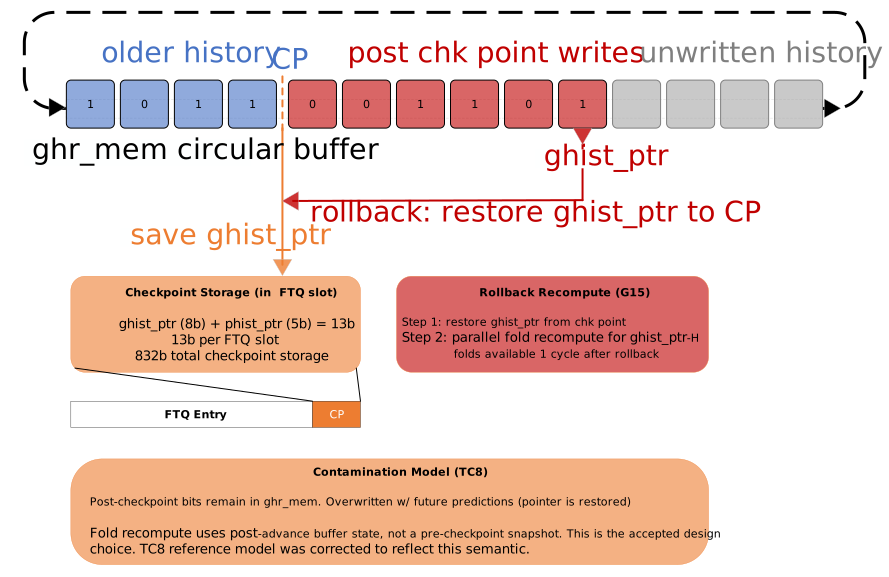
The checkpoint design is the most consequential structural decision in this module. The naive approach stores the full GHR content per FTQ slot: 256 bits per checkpoint at 64 slots is 16,384 bits of storage, before folds. The chosen approach stores only the two pointer values: ghist_ptr (8 bits) and phist_ptr (5 bits), for 13 bits per slot and 832 bits total. Folds are not checkpointed. On rollback, folds are recomputed from the circular buffer contents at the restored pointer.
The reasoning is that the circular buffer itself is the history. Entries written after a checkpoint remain in the buffer on rollback – they are not cleared – but they become unreachable via the restored pointer. The fold recompute traverses the buffer from the restored pointer position, reading H consecutive bits per fold and XOR-folding to width W. This recomputation is available one cycle after rollback_en asserts.
The timing concern is real: 27 folds recomputed in one cycle from a 256-bit circular buffer is a non-trivial combinatorial path. This is logged as G15 in the planning document and deferred until the critical path is characterized. The architecture is correct and passes all directed tests; the timing risk is accepted with open eyes.
TC8 in the BP-002 testbench confirmed a non-obvious semantic: because the buffer is not cleared on rollback, GHR entries written after the checkpoint remain in the buffer and can fall within the fold computation window when H is large enough to reach them. The fold recomputed after rollback is computed from the post-advance buffer state, not a frozen pre-checkpoint snapshot. The TC8 reference model was corrected to reflect this, and the behavior is architecturally correct for a pointer-based circular buffer design. This is the accepted contamination model: the contaminating entries are unreachable for future predictions but their bits remain in the buffer and contribute to fold recomputation.
FIG: History Module - Claude
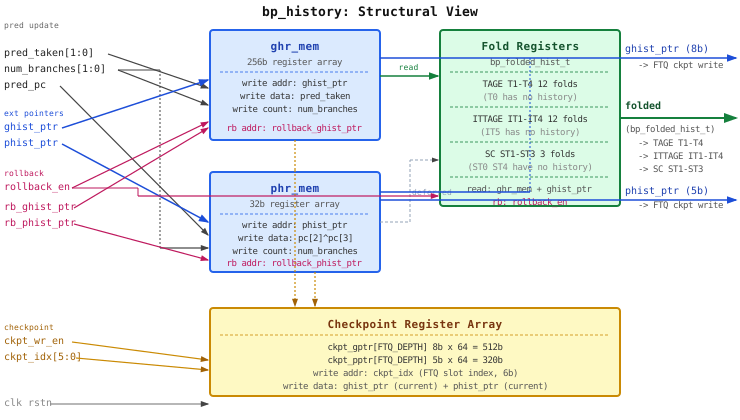
FIG: GHR Circular Buffer, Checkpoint and Rollback - User
uBTB Design
The uBTB is the first predictor in the prediction pipeline. It takes the fetch PC at s0 and produces a prediction at s1, one cycle later. Its role is narrow: supply a next-PC prediction early enough to start speculative fetch before any slower predictor has fired. It does not generate a redirect signal. It supplies a prediction or withholds one. On a miss, fetch proceeds sequentially at PC + fetch_width. The first cycle at which any predictor can redirect fetch is s2.
Structure and Lookup
The uBTB is 256 entries organized as 64 sets of 4 ways (UBTB_ENTRIES = 256, UBTB_WAYS = 4, UBTB_SETS = 64). The set index is derived from PC[7:2], six bits that address the 64 sets while dropping the two least-significant bits that are always zero for aligned instructions. The tag is PC[26:7], 20 bits. Each entry stores: a valid bit, the tag, the branch type, the predicted target, the predicted direction for conditional branches, and a carry bit.
FIG: uBTB Entry Fields - Claude
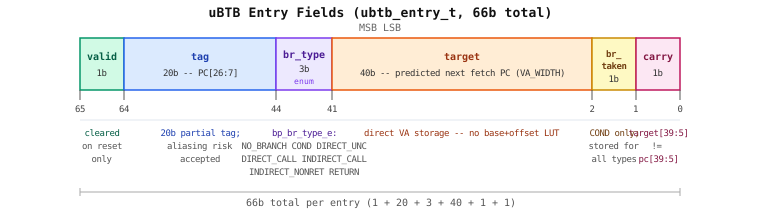
The carry bit indicates whether the predicted target falls in a different 32-byte-aligned fetch block from the current fetch PC:
carry = target[VA_WIDTH-1:5] != pc[VA_WIDTH-1:5]
The cluster uses this to determine whether the s1 prediction requires switching to a new fetch block or continuing within the current one.
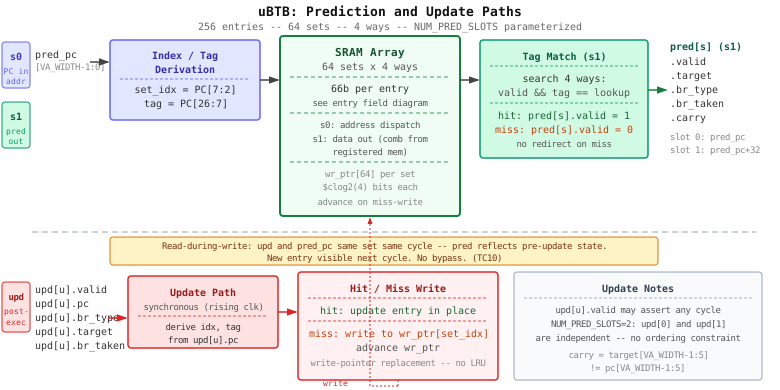
The prediction path is combinational from registered memory. The set index and tag are derived from pred_pc in s0. The registered array produces a hit or miss output at the start of s1, one cycle later. The 20-bit tag is relied upon to make aliasing acceptably rare for a 64-set table. No disambiguation beyond valid-and-tag-match is performed.
FIG: uBTB Structure - Claude
Read-During-Write
The update path is synchronous. When upd[u].valid asserts – where upd[u] is the resolved update bundle driven by the post-execute resolution path for prediction slot u – the target set is searched for an existing entry with matching tag. A hit updates the entry in place. A miss writes to the way pointed to by the per-set write pointer, which then advances. The replacement policy is per-set write pointer only: no hit promotion, no LRU.
The read-during-write contract is that if an update and a lookup address the same set in the same cycle, the prediction reflects pre-update (registered) state. The new entry becomes visible on the following cycle. No bypass path is implemented. TC10 in the BP-003 testbench confirmed this behavior by checking the prediction between clock edges on the same cycle as the update, then confirming visibility one cycle later.
Dual Prediction
The uBTB is parameterized on NUM_PRED_SLOTS at elaboration time. When NUM_PRED_SLOTS = 2, there are two independent prediction outputs and two independent update channels. Slot 0 uses pred_pc directly. Slot 1 uses pred_pc + 32, the next 32-byte fetch block. The reason for pred_pc + 32 is that slot 1 must form its s0 address request before the slot 0 result is available: the direction and target of any taken branch in slot 0 are not resolved until s1 at the earliest. Using pred_pc + 32 as the slot 1 input is a speculative stand-in for the sequential next block. If slot 0 produces a taken branch, s2 will redirect to the actual target; if slot 0 is not taken or has no branch, the prediction at pred_pc + 32 is already correct. The two update channels are processed independently with no ordering constraint between them. TC9 verified that a simultaneous hit on both slots produces correct independent predictions in a single cycle.
When NUM_PRED_SLOTS = 1, one prediction output and one update channel are active. Single-slot mode is for silicon debug only and is not a production configuration.
Branch Type Encoding
The UBTB_BR_* localparams that appeared in the initial BP-003 implementation were introduced by the PA-authored experiment prompt, which specified them as the branch type encoding for the three uBTB structs (ubtb_entry_t, ubtb_pred_t, ubtb_upd_t). A pre-existing enum, bp_br_type_e, already covered the same semantic space with finer granularity: seven values (NO_BRANCH, COND, DIRECT_UNC, DIRECT_CALL, INDIRECT_CALL, INDIRECT_NONRET, RETURN) compared to the six UBTB_BR_* values, which collapsed DIRECT_CALL and INDIRECT_CALL into a single entry. The IA implemented the structs as specified and flagged the conflict with bp_br_type_e in the results capture as an RVA23 compliance gap requiring a translation step at integration. The PA identified the fix from that results capture and authored BP-003-FIX.
BP-003-FIX retired UBTB_BR_* entirely and updated all three uBTB structs to use bp_br_type_e directly. TC6 was expanded from 6 to 7 entries to cover all enum values. The resolution path now stores exactly the encoding the FTQ and update channel expect with no translation. ubtb.sv itself required no changes because the module stores and forwards br_type without interpreting encoding values.
The pre-decoder that produces the post-execute update distinguishes DIRECT_CALL from INDIRECT_CALL from instruction bits (opcode plus rd and rs1 fields) before anything is written to the uBTB. The encoding that arrives at the update input is already correct by the time the update fires.
Experiments BP-002, BP-003, and BP-003-FIX
The BP-002 experiment covered the full history module implementation: the circular buffers, 27 incremental fold computations, the checkpoint storage array, and the rollback recompute path. The resulting module was 537 lines of verified SystemVerilog. The 12-case testbench (TC1 through TC12) covered reset state, single and dual branch writes to the GHR, PHR path bit updates for both XOR values, checkpoint and rollback for GHR and PHR separately, fold non-zero verification after alternating updates, fold recompute after rollback with contamination, zero-branch no-op behavior, dual-slot writes to consecutive GHR positions, checkpoint preservation across an unrelated rollback, and GHR pointer wraparound.
TC8 required a reference model correction after the initial testbench draft was written, as described in the previous section. Correcting the reference to match the actual rollback semantics made TC8 a meaningful test of a non-obvious property rather than a tautology. The corrected semantics are now specified in the bp_history interface specification.
BP-002 also surfaced a Verilator include-path issue: RTL files that use `include directives fail if no -I path is given on the Verilator command line, even when the included file is in the same directory. The fix – passing all files explicitly on the Verilator command line rather than using `include in RTL – was logged as a standing project rule.
BP-003 covered the full uBTB module and testbench. All ten test cases passed on the first full run after one package import style correction carried over from BP-002. BP-003-FIX, which retired UBTB_BR_* and expanded TC6, passed with no new test failures.
Two Verilator suppression rules were established during BP-003 and graduated to the project CLAUDE.md. The first, -Wno-IMPORTSTAR, is required project-wide because the mandated file-scope wildcard import style (import bp_pkg::*; before the module declaration) triggers a Verilator 5.020 warning about $unit namespace pollution. The warning is structural. The second, -Wno-VARHIDDEN, is scoped to individual sim targets when a module parameter intentionally shadows a bp_pkg parameter of the same name. The NUM_PRED_SLOTS parameter in ubtb.sv is the override point for instantiation; the package parameter is the default. Renaming the module parameter would violate the interface specification, so the suppression is the correct resolution, applied locally rather than globally.
Prompt Discipline
The BP-002 and BP-003 prompts followed the constraint-first pattern established in BP-001. The BP-002 Binding Previous Decisions section specified eight items that had been settled in prior planning sessions but were not yet in bp_cluster.md or were easy to get wrong without explicit direction: the pointer-external model, the no-fold-checkpoint decision, the SC history depths (4, 10, 16 bits for ST1 through ST3), the specific folds required by each ITTAGE table, and the bp_ftq_entry_t field change from a 256-bit raw snapshot to a pair of pointer fields.
A practical consequence of that specificity appeared immediately. A planning review before BP-002 ran caught five errors in the draft prompt and planning document. The errors involved incorrect labels, wrong history depth values, incorrect fold assignments, and a false assumption about checkpoint content. The user identified all five errors during the pre-run review of the PA-authored draft. All were caught before any RTL was generated. The session record does not further separate which errors originated in the user’s initial direction and which in the PA’s drafting; that attribution gap is a methodology note already documented in Part 1.
The ratio metric from Part 1 extends to BP-002: 537 lines of verified RTL and 450 lines of testbench from a two-page experiment prompt represents approximately the same leverage. BP-003 at 7 minutes of runtime and 10 passing test cases from a comparably sized prompt extended the pattern. Both prompts are primarily architectural constraint, not implementation dictation.
Experiment Summary
| Experiment | Description | Status | Checks | RTL Lines | Runtime | Context |
|---|---|---|---|---|---|---|
| BP-002 | bp_history.sv, GHR/PHR/folds | PASS | 12/12 | 537 | 18m.22s | 30%+ |
| BP-003 | ubtb.sv, 4-way associative | PASS | 10/10 | – | 7m.21s | 38% |
| BP-003-FIX | Encoding unification, cleanup | PASS | 10/10 | 0 new | 4m.31s | 34% |
What Comes Next
With the history module and uBTB implemented and verified, the first two modules of the s1 prediction infrastructure are in place. The history module produces the 27 folded histories that every TAGE-family predictor depends on. The uBTB produces the first prediction that speculative fetch acts on.
The next module is the loop predictor: a 256-entry 4-way associative predictor that fires at s1 alongside the uBTB and can override the uBTB prediction when a loop branch is detected and its confidence counter is sufficient. The loop predictor is the only predictor in this cluster not derived from the Xiangshan Kunminghu architecture. Its design, implementation, and verification are covered in Part 3.
Design Process Notes
Domain knowledge supplied by the user
The circular buffer model for the GHR and PHR was user-directed. The key structural decision – that pointers are external inputs while buffer storage is internal – came from the user as an explicit architectural constraint. The PHR update rule and the specific fold assignments per predictor table were also user-supplied, as were the SC history depth values (4, 10, 16 bits for ST1 through ST3).
Those history depth values were initially transcribed incorrectly in the planning document before BP-002 ran, appearing as 16 and 64 bits rather than 4, 10, and 16. This was one of five errors caught during a pre-run planning review. The others were: an incorrect label applied to SC table ST4 (the BrIMLI label belongs to ITTAGE IT5, not ST4), ITTAGE IT5 fold entries incorrectly included in the draft bp_folded_hist_t definition (IT5 has no history and therefore no folds), the checkpoint design incorrectly stated to store folded histories rather than pointer values only, and IT1-IT5 listed as fold providers where IT1-IT4 was correct. The user identified all five errors during the pre-run review of the PA-authored draft.
What the PA contributed
The PA authored the BP-003 experiment prompt, which introduced the UBTB_BR_* localparams as the branch type encoding for the uBTB structs. The IA implemented them as specified, flagged the conflict with bp_br_type_e as an RVA23 compliance gap in the results capture, and the PA identified and authored the fix as BP-003-FIX. The PA also wrote the bp_history and uBTB interface specification documents (bp_history_interfaces.md and ubtb_interfaces.md), which formalize port semantics, timing contracts, and consumer and producer obligations for each module. These were written after BP-003 passed and are outputs of the session, not inputs to it.
The rollback semantic clarification – that fold recompute operates on post-advance buffer state – was first documented by the IA in the BP-002 results capture, discussed in the session that followed, and incorporated into the interface specification by the PA.
What the prompt constrained versus what the IA filled in
The BP-002 prompt specified the full port list, the circular buffer write rules for both active slots, the incremental fold update formula, the fold recompute trigger condition, and the exact checkpoint field list. It did not specify how fold_step() should be structured, how many always_ff blocks the module should use, or what the reset strategy for the checkpoint array should be. Those were IA decisions.
The IA’s results capture documented two assumptions not in the prompt: that num_branches value 2’b11 is undefined and will not be presented, and that ckpt_ghist_ptr and ckpt_phist_ptr track the most recently written checkpoint values as combinational outputs rather than following the rollback pointer. Both were raised explicitly, both were accepted without change, and both are now specified in the bp_history interface specification.
For BP-003, the prompt specified the index derivation (PC[7:2]), tag derivation (PC[26:7]), carry bit definition, read-during-write contract, and replacement policy. The IA wrote all SystemVerilog syntax, structured the way loops for lookup and update, and handled the dual-DUT instantiation required for TC9 within a single testbench module. The VA_WIDTH = 40 bit gap against Sv48 was noticed and flagged by the IA in the results capture; it is a known accepted decision documented in bp_cluster.md and requires no action at this stage.
The generalization
The two modules in this session pair illustrate a structural property of the methodology at the module level. Modules with purely registered state and well-defined update semantics (bp_history) are fast to specify and fast to verify: the interface is the design, and the testbench follows directly from the interface. Modules with SRAM structures and multiple access patterns (ubtb) require more test cases to cover the combinatorial space of hit, miss, tag collision, replacement, and read-during-write behavior, but the same interface-first approach applies. In both cases, prompt length was comparable, runtime was short, and verification was complete before the session ended.
References
[1] A. Seznec and P. Michaud, “A Case for (Partially) TAgged GEometric History Length Branch Prediction,” Journal of Instruction Level Parallelism, vol. 8, Feb. 2006.
[2] Wang, Kaifan, et al. “XiangShan open-source high performance RISC-V processor design and implementation.” Journal of Computer Research and Development 60.3 (2023): 476-493.