A New Aspect of Co-Design
This is the first of a set of posts on the design and execution of the branch prediction unit (BPU), beginning with task file BP-001. The design of the BPU exercises different aspects of the co-design methodology, with more research and more interaction with the user for the planning assistant (PA, Claude.ai).
The RVA23S64 decoder is, by definition, a specification-driven design, with clear implementation requirements. There are more tradeoffs and choices to be made in the BPU design. In developing the decoder the PA provided instructions for the implementation assistant (IA, Claude Code) on where to look for the definitions (riscv-opcodes [1]) and expectations on implementation. The PA’s role in the decoder track was to segment the complete task into experiment files and load-balance each against the IA’s context budget. In developing the BPU the PA role will expand with greater interaction in web research and user dialog.
Branch prediction is well-researched but with opportunities for innovation and customization not present in a strict specification driven implementation like RVA23.
The PA researched public information on BPU configurations for commercial and open source designs [2] [3] [4]. The PA was also instructed to assess the results of the branch prediction championships [5] [6] to mine for component configurations and parameters. Finally there is the extensive body of research literature covering predictor algorithms, table sizing, history management, and inter-component interactions. In the early BPU co-design sessions the user contributed known predictor configurations and domain knowledge of the redirect architecture. The PA researched alternative configurations, synthesized published documentation, and drove the RAS micro-architecture research from external sources. The BPU configuration emerged from that exchange.
This is the first exercise of the PA as a research partner on architecture questions, not just an orchestrator of implementation tasks, this shift in role surfaced methodology gaps – in particular, error attribution and planning review discipline – that subsequent sessions addressed directly.
The fabrication errors caught before BP-002 illustrate a hazard in this mode. Origins were mixed: ambiguous or incomplete direction from the user, PA extrapolation beyond what was specified, and IA (Claude Code assistant) assumptions for undefined elements. The session record does not separate these cleanly. That gap is itself a methodology note – error attribution in a multi-session AI-assisted flow requires more deliberate capture than was applied here. The errors were caught in a joint planning review before any RTL was generated, at low cost. Mid-implementation discovery would have been significantly more expensive.
The predictor hierarchy, table sizes, and staging decisions recorded here are working engineering choices subject to performance analysis as the design matures.
Predictor Hierarchy
The BP cluster contains seven predictors: a micro Branch Target Buffer (uBTB), a loop predictor (LP), a Fetch Target Buffer (FTB), a tagged geometric history length predictor (TAGE) [7], a Statistical Corrector (SC) [8], an indirect target TAGE predictor (ITTAGE) [9], and a Return Address Stack (RAS) [10].
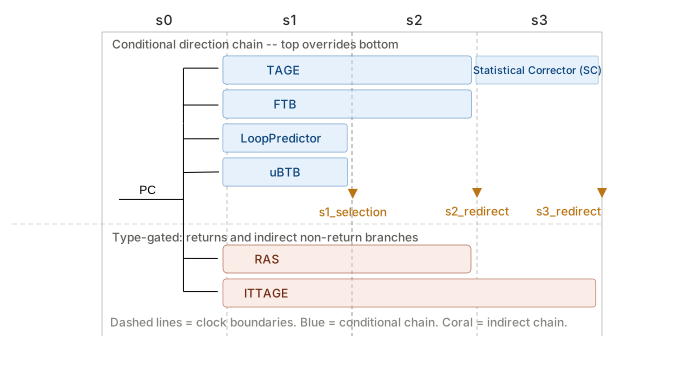
The diagram makes the distinction between the conditional predictors and the target predictors. The predictors in each group operate with the conventional separation of branch types, indirect and conditional. The RAS handles return instructions, the ITTAGE handles target predictor for indirect branches.
The override chain described below applies exclusively to conditional branches. For the conditional group, the SC may or may not override the TAGE prediction based on the confidence of either the TAGE or SC, as such the SC prediction process requires TAGE output to begin.
The cluster supports dual prediction: two independent next-PC predictions per fetch bundle, selected at elaboration time via the NUM_PRED_SLOTS parameter. Dual mode is the default. When dual mode is active, two independent update channels handle both conditional and indirect branch resolution concurrently. Single-channel mode exists for silicon debug and is not a production configuration.
The initial configuration of the BPU elements are parameter driven. The parameters are summarized in Predictor Parameter Reference
Predictor Operation
The uBTB is a single-cycle predictor. The PC is presented in s0 and the prediction result is available in s1. It is a 256-entry 4-way associative table that provides the first next-PC prediction and starts speculative fetch. It does not generate a redirect signal; it either supplies a prediction or withholds one. On a miss, fetch proceeds sequentially until a later stage corrects it.
The LP is also a single-cycle predictor, presenting its result in s1. The LP prediction overrides the uBTB prediction if a loop branch is detected and the LP has sufficient confidence. The override control reads the LP confidence counter and determines whether the LP prediction should be used.
The FTB is a two-cycle predictor. The PC is presented in s0 and the hit/miss/prediction result is available in s2. The FTB is the authoritative branch prediction selector, providing the redirect control logic with branch type. Returns use the RAS target address; indirect non-return branches use the ITTAGE target prediction; conditional branches use the uBTB, LP, TAGE, or TAGE+SC predictions. In the conditional branch chain, later predictors are by design more accurate. If a later predictor does not contradict an earlier predictor there is no need for redirection.
TAGE is also a two-cycle predictor, presenting its result in s2. The SC predictor uses the TAGE s2 result as input and supplies its prediction in s3. This TAGE-then-SC arrangement is standard in the branch prediction literature, and various latency optimizations exist to reduce the delay.
ITTAGE is a three cycle predictor. The PC is presented in s0 and the result is available in s3.
Conscious Design Choices and Future Experiments
Several deliberate design choices in this micro-architecture are worth pointing out as each represents a planned experiment in the PA/IA co-design methodology.
The loop predictor is included as a deliberate architectural choice. Loop predictors in high-performance decoupled front-end designs have become less common. The cost-benefit trade-off will be evaluated during performance analysis; inclusion or exclusion will follow from that result. This will also serve as an exercise in the PA/IA methodology for performance analysis.
The TAGE and SC configuration is conventional. There are publications [11] that modify this arrangement, enabling the SC to use a simplified TAGE output one cycle earlier. An experiment will be structured to determine whether the PA/IA can identify these modifications from the literature, implement them, and measure the performance benefit.
The ITTAGE design is structurally similar to TAGE but conventionally requires an extra cycle to form the full target address, using a look-up table and adder that accept a region pointer and offset from the TAGE-like structures. Under some conditions it is possible to choose a virtual address range that fits directly in the TAGE-like entry, saving that cycle. This is a performance-analysis-driven decision; the PA/IA methodology will be used to research the applicable conditions, provide the implementation, and measure the benefit in a future performance analysis step.
A pre-decode branch detection stage can provide an early branch type hint to the RAS ahead of the FTB s2 result, reducing the redirect penalty on return-heavy workloads. This is also a opportunity to exercised the performance analysis phase of the PA/IA methodology.
Redirect Architecture
Two distinct concerns drive redirects in this cluster: conditional branch direction and branch target. This section covers each separately.
Direction
Direction prediction for conditional branches proceeds in three stages. The uBTB and loop predictor supply the initial direction at s1; speculative fetch begins on that result. TAGE refines the conditional direction at s2. The SC may further override the TAGE s2 direction at s3. The FTB has no direction prediction role.
The s2_redirect direction trigger fires when TAGE produces a conditional direction that contradicts the s1 prediction. The s3_redirect direction trigger fires when the SC overrides the TAGE s2 direction.
Target
Target selection is type-gated throughout. The FTB provides targets for direct branches. The RAS provides return addresses for returns. ITTAGE provides targets for indirect non-return branches.
The s2_redirect target triggers are: the FTB producing a target or branch type that contradicts the uBTB prediction, and the RAS producing a return address that differs from the uBTB prediction. When s2_redirect fires, type-gate priority determines the selected target: RAS for returns, raw ITTAGE for indirect non-return branches, FTB target for all direct branches. The FTB entry is held for use at s3.
At s3_redirect, the target comes from the FTB result held from s2. ITTAGE may refine an indirect target at s3 if the s2 redirect used a raw pre-final ITTAGE result.
Pipeline Staging
The direction timeline is as follows. In s0, all predictors begin index calculations. In s1, the uBTB and loop predictor direction results are valid and speculative fetch begins. In s2, the TAGE direction result is valid; s2_redirect fires on direction if TAGE contradicts the s1 prediction. In s3, the SC direction result is valid; s3_redirect fires if SC overrides the TAGE s2 direction.
The target timeline proceeds in parallel. In s0, the FTB, TAGE, SC, and ITTAGE dispatch their SRAM addresses. In s2, the FTB and RAS results are valid; s2_redirect fires on target if either contradicts the uBTB prediction; the FTB entry is held for s3. In s3, ITTAGE finalizes; an indirect target may be refined if s2 used a pre-final ITTAGE result.
The design accepts up to two in-flight redirect operations as the cost of running the full predictor hierarchy. For a server-class, 8-issue, out-of-order processor, the accuracy benefit from the full hierarchy is expected to exceed the redirect penalty. That expectation will be confirmed through performance analysis.
Return Address Stack Design
The RAS uses a dual-stack design [10]: a speculative stack implemented as a persistent linked circular array, and a separate commit stack implemented as a conventional circular structure. The speculative stack is the primary prediction structure; the commit stack holds only confirmed, architecturally committed return addresses and serves as a fallback.
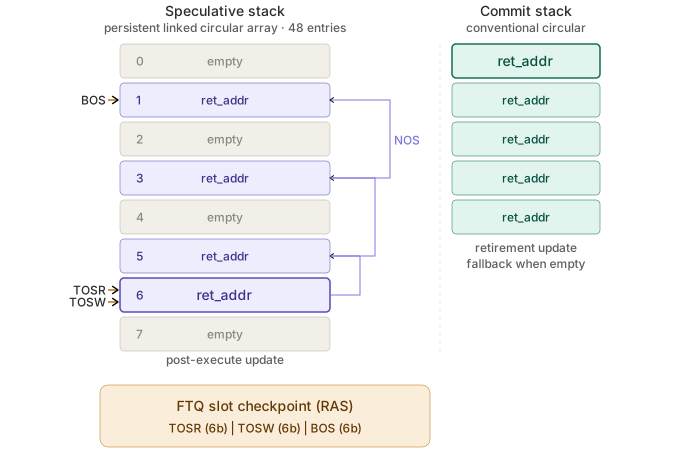
A naive circular stack corrupts entries under deep speculative execution in an out-of-order machine. When a branch mispredict causes a rollback many cycles deep, a series of speculative push and pop operations may have overwritten entries below the stack top that are still needed. A conventional stack cannot recover those entries without replaying every individual operation from the rollback point, which is complex and costly. The persistent linked array avoids this entirely.
The speculative stack never overwrites data. Push advances the write pointer TOSW (Top Of Stack Write), allocates a new slot, and records the previous TOSR (Top Of Stack Read) as the NOS (Next-On-Stack) pointer. Pop follows the NOS of the current top without removing any data. Redirect recovery reduces to restoring three pointer values – TOSR, TOSW, and BOS (Bottom Of Stack) – from a snapshot stored per FTQ (Fetch Target Queue) slot. The full history of speculative stack states is preserved in the linked array with no replay required.
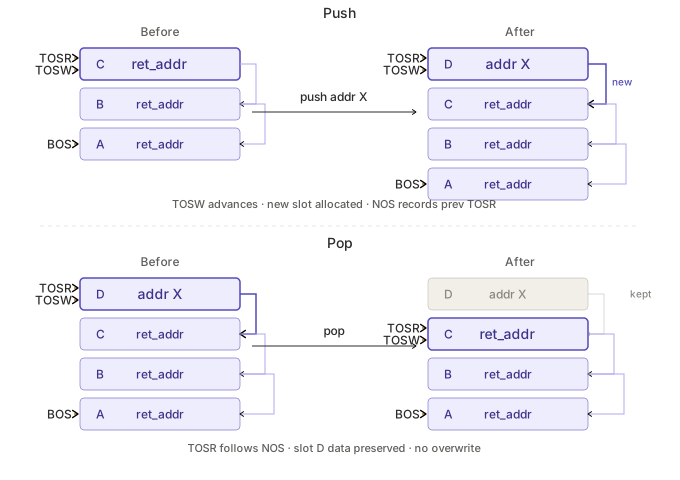
When the speculative stack is empty during a pop, the commit stack top is used as the fallback prediction without consuming the entry. Committed state must not be modified speculatively, so the entry is read but not popped.
The commit stack update policy is an intentional exception to the general BP cluster update policy. All main predictor tables – TAGE, SC, ITTAGE, uBTB, and the loop predictor – are updated post-execute, as soon as branch resolution is known by the execution unit, without waiting for retirement. The RAS commit stack is specifically tied to retirement because it records the architecturally committed call and return state, not the speculative state.
At s3, if the s3 structural prediction disagrees with the s2 stack operation, an inverse repair is applied: a push at s2 that s3 considers incorrect is repaired with a pop, and vice versa. Push-to-pop and pop-to-push cannot occur within a single s2/s3 pair.
Call and return detection follows RISC-V register conventions. A call is a JAL, JALR, or C.JALR where the destination register is x1 or x5. A return is a JALR, C.JR, or C.JALR where the source register is x1 or x5, with C.JALR using x5 excluded from return classification. JALR prediction is split three ways: the FTB handles stable-target calls, the RAS handles convention-matched returns, and ITTAGE handles history-dependent indirect dispatches.
FTQ Entry Split
The FTQ entry is split into two parallel SRAMs indexed by the same FTQ slot. The fast-path entry is read every prediction cycle and carries the prediction result, branch type, predicted target, source predictor, and the history pointer checkpoints needed for redirect recovery. The slow-path meta entry is read only on post-execute update and carries all predictor-internal metadata needed to update each table correctly after branch resolution.
The split is motivated by timing. A wide metadata entry that accumulates TAGE provider and alternate-provider indices, saturating counter snapshots, SC counter values, loop predictor iteration counts, and ITTAGE flags should not sit on the timing-critical read path. Separating it to a wider, less frequently accessed SRAM removes it from that path entirely.
The FTQ depth is 64 entries, giving 6-bit branch identifiers that serve as the shared key across both SRAMs and as the rollback address for redirect recovery. History checkpoints in the fast-path entry store only the GHR (Global History Register) and PHR (Path History Register) circular buffer pointers, not the folded histories. Folded histories are recomputed on rollback from the circular buffer contents. The checkpoint cost per FTQ slot is 13 bits (8b for the GHR pointer, 5b for the PHR pointer) rather than the 288 bits a full snapshot of both buffers would require.
Predictor Parameter Reference
The tables below consolidate all predictor parameters in one place for reference. Parameters marked TBD are deferred to the relevant implementation session.
Global Parameters
| Parameter | Value | Notes |
|---|---|---|
| VA_WIDTH | 40b | Virtual address width |
| GHR_WIDTH | 256b | Global history register depth |
| PHR_WIDTH | 32b | Path history register depth |
| GHIST_PTR_BITS | 8b | GHR circular buffer pointer width |
| PHIST_PTR_BITS | 5b | PHR circular buffer pointer width |
| FTQ_DEPTH | 64 | Fetch target queue entries |
| FTQ_IDX_BITS | 6b | FTQ slot index width |
| FETCH_BLOCK_BYTES | 64 | Fetch block size in bytes |
| NUM_PRED_SLOTS | 1 or 2 | Elaboration-time dual predict mode |
uBTB
| Parameter | Value | Notes |
|---|---|---|
| UBTB_ENTRIES | 256 | Total entries |
| UBTB_WAYS | 4 | Associativity |
| UBTB_SETS | 64 | Sets (ENTRIES / WAYS) |
| UBTB_IDX_BITS | 6b | PC[7:2] |
| UBTB_TAG_BITS | 20b | PC[26:7], accepted aliasing risk |
| Entry width | 66b | valid+tag+br_type+target+taken+carry |
Loop Predictor
| Parameter | Value | Notes |
|---|---|---|
| LP_TBL_ENTRIES | 256 | Total entries |
| LP_TBL_WAYS | 4 | Associativity |
| LP_N_SETS | 64 | Sets (ENTRIES / WAYS) |
| LP_IDX_BITS | 6b | Derived from LP_N_SETS |
| LP_TAG_BITS | 14b | Tag width |
| LP_ITR_BITS | 14b | Iteration counter width |
| LP_CNF_BITS | 2b | Confidence counter width |
| LP_AGE_BITS | 8b | Age/replacement counter width |
FTB
| Parameter | Value | Notes |
|---|---|---|
| FTB_ENTRIES | 2048 | Total entries |
| FTB_WAYS | 8 | Associativity |
TAGE
| Table | Banks | Entries | Tag | CTR | Useful | History |
|---|---|---|---|---|---|---|
| T0 | 2 | 2048 | – | 2b | – | – |
| T1 | 2 | 2048 | 8b | 3b | 2b | 8b |
| T2 | 2 | 2048 | 8b | 3b | 2b | 13b |
| T3 | 2 | 2048 | 8b | 3b | 2b | 32b |
| T4 | 2 | 2048 | 8b | 3b | 2b | 119b |
T0 is the base table: 2b CTR only, no tag, no valid, no useful field. T1-T4 are tagged tables: 1b valid, 8b tag, 3b CTR, 2b useful per entry. Each tagged table maintains three folded histories (index, tag_fh1, tag_fh2).
SC (Statistical Corrector)
| Table | Entries | Width | History | Folds | Notes |
|---|---|---|---|---|---|
| ST0 | 512 | 6b | 0b | none | No history |
| ST1 | 512 | 6b | 4b | 1 | Index fold only |
| ST2 | 512 | 6b | 16b | 1 | Index fold only |
| ST3 | 512 | 6b | 64b | 1 | Index fold only |
| ST4 | 1024 | 6b | none | none | Direct mapped |
IT5 and ST4 were a source of an error in the specification and subsequent implementation. The error was captured on review.
Initially IT5 was mistakenly specified as a BrIMLI table, obviously incorrect for an indirect target predictor branch table. The tables that are shown here have been corrected to avoid confusion in the references.
ST4 is the BrIMLI table. The parameters in the tables have been corrected. The ST4 implementation is for 64 byte regions.
Future work will explore the cost/benefit of the branch source (BrIMLI) and branch target (TaIMLI) counters and the two sizes of each found in Seznec[12], 64B and 4B regions.
ITTAGE
| Table | Banks | Entries | FH | FH1 | FH2 | History | Notes |
|---|---|---|---|---|---|---|---|
| IT1 | 2 | 256 | 4b | 4b | 4b | 4b | 38b target |
| IT2 | 2 | 256 | 8b | 8b | 8b | 8b | 38b target |
| IT3 | 2 | 512 | 9b | 9b | 8b | 13b | 38b target |
| IT4 | 2 | 512 | 9b | 9b | 8b | 16b | 38b target |
| IT5 | 2 | 512 | 9b | 9b | 9b | 32b | 38b target |
Targets stored as Sv39-1 in width VA_WIDTH (40b) values.
RAS
| Parameter | Value | Notes |
|---|---|---|
| Speculative entries | 48 | Persistent linked circular |
| ret_addr width | 41b | FTB fallThroughAddr |
| NOS pointer width | 6b | log2(48) |
| Recursion counter | TBD | Deferred to implementation |
| TOSR / TOSW / BOS | 6b ea | Snapshot stored per FTQ slot |
| Commit stack entries | TBD | Smaller than speculative stack |
History Module
| Parameter | Value | Notes |
|---|---|---|
| GHR_WIDTH | 256b | Circular buffer, pointer-addressed |
| PHR_WIDTH | 32b | Circular buffer, pointer-addressed |
| Total folds | 27 | 12 TAGE + 12 ITTAGE + 3 SC |
| Checkpoint | 13b | ghist_ptr (8b) + phist_ptr (5b) per slot |
| PHR folding | TBD | Deferred to TAGE/ITTAGE implementation |
Interface First: BP-001
The co-design discipline from the decoder track carries forward: define the complete SystemVerilog type package before writing any implementation module. For the BP cluster, this meant capturing every parameter, enumeration, and struct definition in a single shared package file, bp_pkg.sv, before the uBTB, loop predictor, history module, or any other module was started. This package is the single source of truth for all types, widths, and structural constants shared across the cluster. Having it locked and verified before implementation begins ensures that every subsequent module is built against a consistent, tested foundation. This was experiment BP-001.
BP-001 produced bp_pkg.sv (397 lines containing all BP cluster parameters, enumerations, and struct type definitions), a self-checking combinational testbench tb_bp_pkg.sv (207 lines), and a Makefile with lint and simulation targets (33 lines). All 15 checks passed on the first simulation run after one Verilator flag addition for a naming convention conflict. Zero errors, zero warnings.
The testbench verified that all structs instantiated correctly, all enum values were distinct, key field widths matched their parameters, and struct packing was consistent across assignment and copy. Catching field-width errors at this stage costs almost nothing; catching them mid-module during a later experiment costs a debugging session and a full context reload.
The session that followed BP-001, before BP-002 was run, caught five errors during a critical review of the planning document and the BP-002 prompt draft. The errors had multiple plausible origins: ambiguous direction from the user, the PA extrapolating beyond what was explicitly specified, and the IA (Claude Code assistant) making assumptions for elements not yet defined. The session record does not separate these causes cleanly, and that is itself a methodology observation noted here.
The most instructive error was a label applied to IT table IT5 that belonged to SC ST4 – a plausible-sounding association between two related but distinct mechanisms that propagated silently into the draft prompt and was caught only through deliberate review. All five errors were corrected before any RTL was generated.
To simplify referencing the table parameters below have been corrected with notation referring to the errors.
Prompt Discipline and AI Leverage
During the architecture extraction sessions a question came up that is worth recording for the methodology record: as experiment prompts become more detailed, does that diminish the leverage the AI assistant provides?
The experience from the decoder experiments and BP-001 suggests the answer is: not if the detail reflects architectural decisions you have already made. The outcome depends on what kind of detail is being added.
Two kinds of prompt detail exist. The first is architectural constraint: specifying that the FTQ entry uses a pointer-only history checkpoint rather than a full GHR snapshot, that the SC index arrays must be split because ST0 through ST3 and ST4 have different index widths and cannot form a uniform packed array, that the RAS snapshot is a sub-struct bundled inside the FTQ fast-path entry. This kind of detail does not diminish AI leverage. It directs that leverage toward the intended architecture rather than letting the assistant invent one. The implementation work – writing correct SystemVerilog, running Verilator, iterating on errors – remains entirely the assistant’s job.
The second kind is implementation specification: dictating how to structure a case statement, which signal names to use at the wire level, exactly which lines of code to write. Prompts that reach this level of detail turn the assistant into a syntax checker. That does diminish leverage.
The prompts in this project sit almost entirely in the first category. A useful test for any given constraint: if you removed it, would the assistant still produce something architecturally correct? If yes, the constraint is probably over-specified. If no, it is earning its place.
A practical metric from the decoder experiments and BP-001: the ratio of RTL lines written by the assistant to prompt lines written by the engineer ran approximately 500 to 1. For BP-001 specifically, 397 lines of verified SystemVerilog and 207 lines of testbench were produced from a prompt of roughly one to two pages of architectural constraint and procedural direction. Prompt length is not the right measure of leverage. That ratio is.
Experiment Summary
| Experiment | Description | Status | Checks | RTL Lines | Runtime | Context |
|---|---|---|---|---|---|---|
| BP-001 | bp_pkg.sv | PASS | 15/15 | 397 | 10m.49s | 50% est |
| type package |
What Comes Next
BP-001 defined the shared parameter and type package that all subsequent modules depend on. The next session begins implementation with the history module: the GHR and PHR circular buffers, the 27 folded histories consumed by TAGE, ITTAGE, and SC, and the checkpoint and rollback mechanism. After that, the uBTB becomes the first prediction-path module with actual SRAM structures and a testbench that exercises hit, miss, and replacement behavior.
Those two modules, which together form the s1 prediction infrastructure, are covered in Part 2 of this series.
Design Process Notes
The architecture described in this post was not derived from a specification. Understanding who contributed which parts of it is relevant to anyone trying to apply this methodology to their own domain.
What the user contributed
The pipeline staging model came from the user: the s0-s3 stage assignments for each predictor, the override chain (SC overrides TAGE which overrides FTB which overrides uBTB), the speculative RAS update policy at s2, and the redirect trigger conditions. The predictor hierarchy itself primarily from domain knowledge, but someone with less BPU experience could use the BOOM/Xiangshan Kunminghu architectures as reference, with one deliberate addition: the loop predictor. Neither Xiangshan or BOOM include a loop predictor. Its inclusion here is a conscious design choice, noted as a future performance analysis experiment.
The user also provided initial parameter values for the TAGE and ITTAGE tables, the FTQ depth and split rationale, and the SC index array layout constraint that emerged during the BP-001 review.
The parameter sets are again something supplied by user domain knowledge but there are multiple sources of detailed parameters in the literature, in the BOOM and Xiangshan designs.
The user caught the five errors in the PA’s first BP-002 draft during the planning review described in the Interface First section above.
What the PA contributed
For the decoder track, the PA’s job was decomposing a fixed external specification into experiment files. For the BPU, the configuration space was open. The PA researched predictor configurations from published championship results, commercial processor disclosures, and open source documentation. It synthesized that material into a coherent set of architectural options, asked clarifying questions that surfaced implicit decisions the user had not yet made explicit, and wrote the complete bp_cluster.md planning document.
The RAS micro-architecture required specific research. The user indicated the direction – persistent linked array, dual stack – and the PA traced that design to its source, identified the pointer structure (TOSR, TOSW, BOS, NOS), confirmed the commit stack update policy, and recommended the speculative s2 update policy over post-execute after laying out the trade-off. The user made the final call with a single response.
The PA also wrote the BP-001 experiment prompt, which is where the interface between PA and IA becomes concrete.
What the prompt constrained versus what the IA filled in
The BP-001 prompt specified struct names, field names, the dependency ordering of struct definitions, naming conventions, file paths, and Makefile targets. It included a Binding Previous Decisions section locking five items that had been settled in prior planning sessions but were not yet in bp_cluster.md – among them the VA_WIDTH = 40 choice (direct VA storage rather than region pointer plus offset) and the exact split between the fast-path and slow-path FTQ SRAMs.
What the IA filled in without guidance: all SystemVerilog syntax, all $clog2 derivations, the packed struct definitions, the testbench self-check logic, and the Makefile. When the IA encountered four open items – the TAGE derived parameter widths, the SC index array split, the RAS snapshot sub-struct bundling, and the FTQ confidence field width – it resolved each, flagged every one explicitly in the Results Capture section, and left no silent assumptions. That behavior is what the interface-first methodology is designed to produce: the IA executes against architectural constraints and surfaces its own assumptions rather than burying them.
The 500:1 line ratio cited in the Prompt Discipline section reflects this division. The number is a measure of leverage, not a measure of how little the engineer did. The constraints that generated that leverage took several sessions of architecture extraction and planning review to arrive at.
The generalization
A domain expert applying this methodology to a different subsystem – a cache hierarchy, a rename unit, a memory disambiguation block – will find the division of labor the same. The user contributes the architectural intent that cannot/difficult to be researched: the tradeoffs that follow from knowing what the machine is supposed to do and how it is expected to be used. The PA contributes the research, the synthesis, and the prompt structure that makes the IA’s output reliable. The IA contributes the implementation work that is time-intensive at scale. Evidence from this session indicates the methodology works effectively with clear separation of roles.
References
[1] riscv-opcodes, https://github.com/riscv/riscv-opcodes, accessed 2026.05.01
[2] Wang, Kaifan, et al. “XiangShan open-source high performance RISC-V processor design and implementation.” Journal of Computer Research and Development 60.3 (2023): 476-493.
[3] Zhao, Jerry, et al. “Sonicboom: The 3rd generation berkeley out-of-order machine.” Fourth Workshop on Computer Architecture Research with RISC-V. Vol. 5. International Symposium on Computer Architecture Valencia, 2020.
[4] Grayson, Brian, et al. “Evolution of the samsung exynos cpu microarchitecture. In 2020 ACM/IEEE 47th Annual International Symposium on Computer Architecture (ISCA).” IEEE, may. 2020.
[5] 6th Championship Branch Prediction (CBP2025), in conjunction with ISCA-52, Tokyo, Japan, June 21, 2025. Organizers: R. Sheikh and S. Jain (ARM), https://ericrotenberg.wordpress.ncsu.edu/cbp2025/ , accessed 2026.05.01
[6] 5th JILP Workshop on Computer Architecture Competitions (JWAC-5): Championship Branch Prediction (CBP-5), in conjunction with ISCA-43, Seoul, South Korea, June 2016. URL: https://jilp.org/cbp2016/ , accessed 2026.05.01
[7] A. Seznec and P. Michaud, “A Case for (Partially) TAgged GEometric History Length Branch Prediction,” Journal of Instruction Level Parallelism, vol. 8, Feb. 2006.
[8] A. Seznec, “TAGE-SC-L Branch Predictors Again,” in JWAC-5: Championship Branch Prediction (CBP-5), June 2016, Seoul.
[9] A. Seznec, “A 64-Kbytes ITTAGE Indirect Branch Predictor,” in JWAC-2: Championship Branch Prediction, June 2011.
[10] Tan Hongze and Wang Jian, “A Return Address Predictor Based on Persistent Stack,” Journal of Computer Research and Development, vol. 60, no. 6, pp. 1337–1345, 2023. DOI: 10.7544/issn1000-1239.202111274
[11] A. Seznec, “TAGE: an Engineering Cookbook,” Inria Technical Report RR-9561, November 2024. Available: https://hal.science/hal-04804900
[12] André Seznec. 2025. TAGE-SC for CBP2025. In CBP 2025 (6th Championship Branch Prediction), June 21, 2025, Tokyo, Japan.
Jeff Nye is a microprocessor architect with 35 years of industry experience spanning performance modeling, RTL implementation, and architecture for high-performance OOO processors. He has contributed RTL to Pentium 4, ARM V7, TI C6x and RISC-V designs, and recently served as sole architect and full-stack implementer of the TAGE-SC-L + ITTAGE branch prediction cluster in an 8-issue RVA23 RISC-V processor — from research through timing closure at 2.75 GHz. He holds +20 issued patents in processor design, architecture, and hardware virtualization. He is the author of Pacino and the uarchlabs methodology documented here.
Connect on LinkedIn.