Showcase
A showcase release is documentation built around testcases and waveforms. Each page follows one program through the RTL and explains what the waveform shows. It is not a specification; the design is described in the architecture pages and the planning documents.
Release 01: Frontend Demo
Twenty-four short programs run on the Pacino frontend, fe_top, with
testbench models of the backend, the page table walker and memory. Each
scenario shows one behavior: prediction and override, the predictors,
redirects, the L1I, translation and faults, compressed code, uncached
fetch, cache maintenance, backpressure and commit. Each run ends in a
PASS or FAIL line and writes an FST waveform. The
Frontend Overview describes the design.
How a Scenario Is Built and Run covers the
testbench, the program writer and how to read the waveforms.
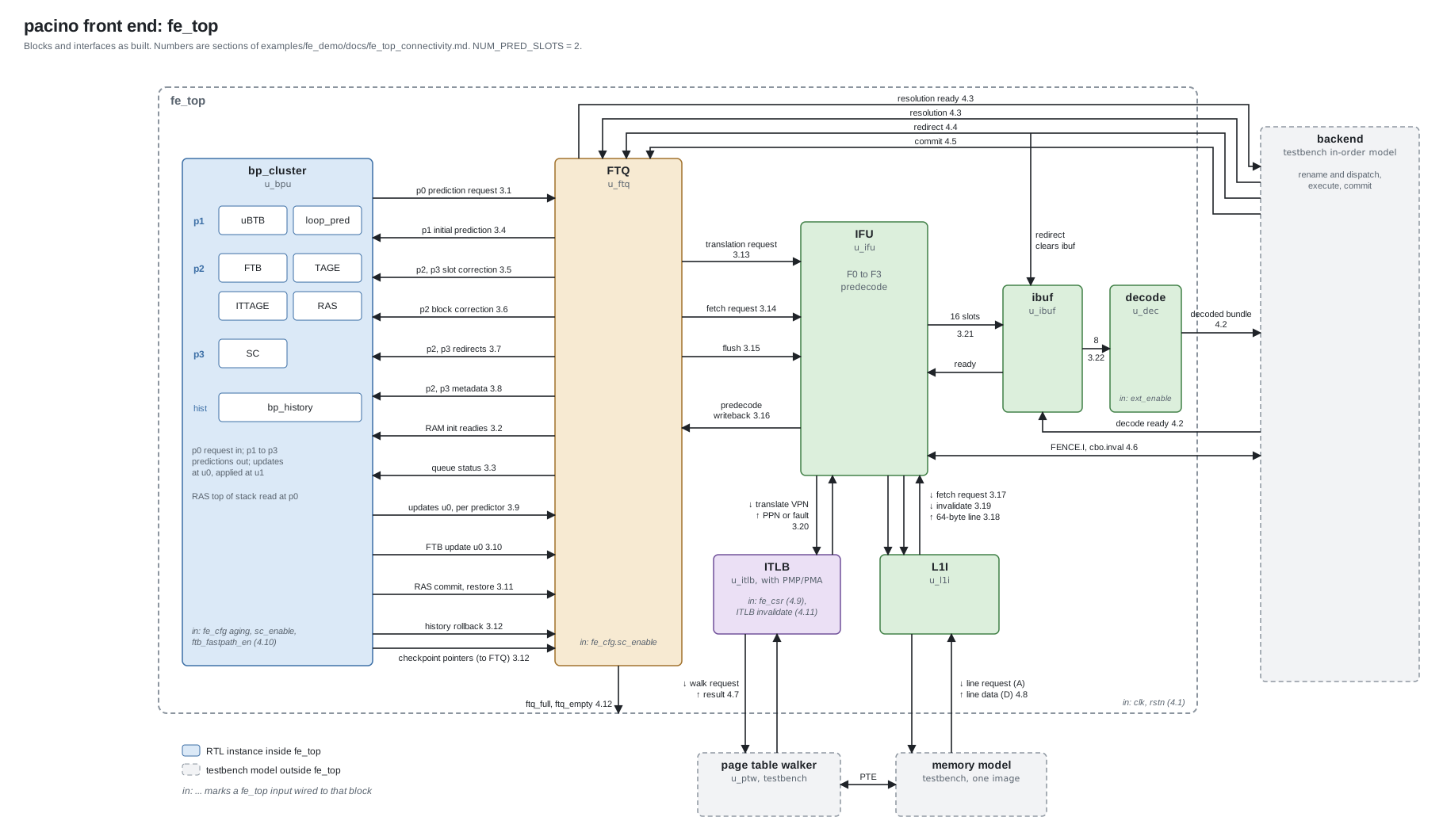
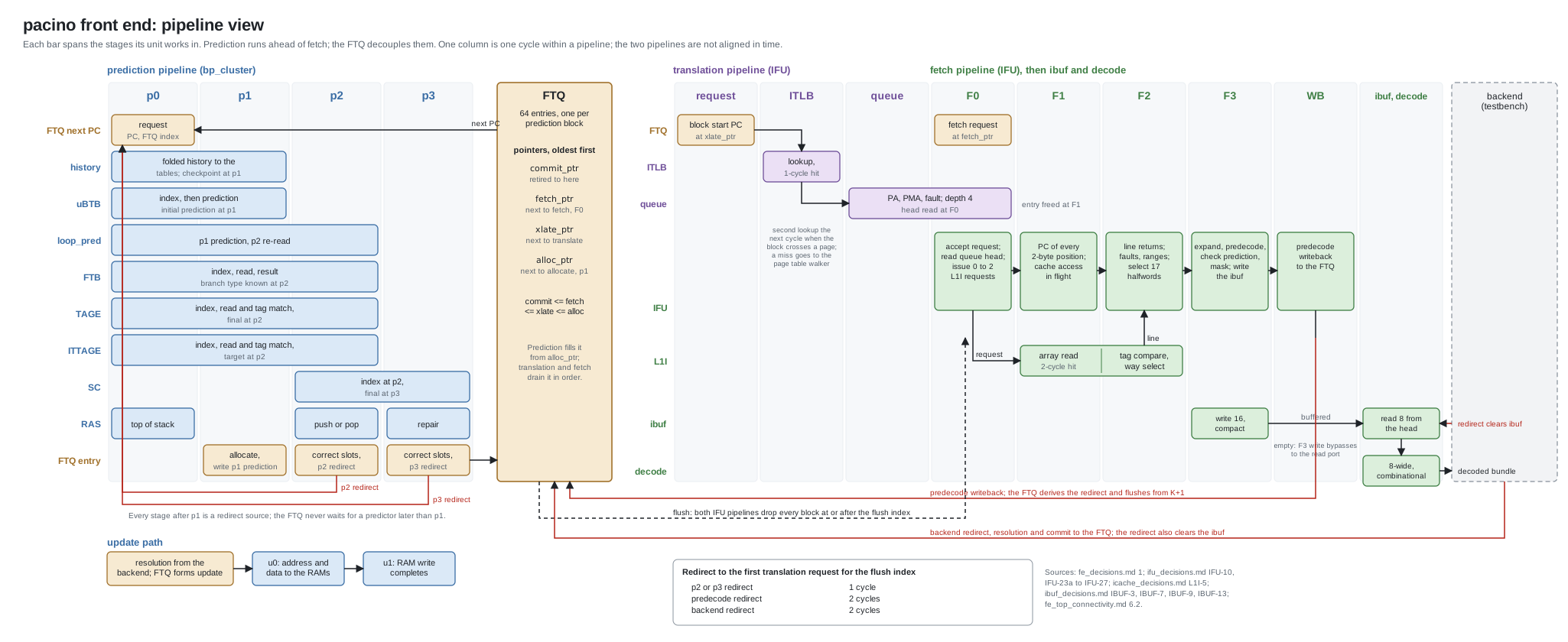
Select either diagram to open it at full size. The signal annotations on the block view refer to the fe_top connectivity inventory.
Running it
From examples/fe_demo/:
make <scenario>          run one scenario; writes out/<scenario>/
make scenarios           run all 24 in order
make view S=<scenario>   open the scenario's waveform in Surfer
make help                list the scenarios
It needs Verilator 5.048 and, for make view, Surfer; the repository
README covers installing both.
Scenarios
Each scenario's waveform opens in Surfer in the browser, with nothing to install.
| FD | Scenario | What it shows | Waveform |
|---|---|---|---|
| 1 | Reset and SRAM Initialization | The TAGE, ITTAGE and SC init walks; no p0 request until all three are ready | Open |
| 2 | Steady-State Prediction and Fetch | Straight-line code: one FTQ entry and eight decoded instructions per cycle | Open |
| 3 | Two Branches in One Block | p1 and p2 predictions with both prediction slots valid | Open |
| 4 | p2 Override | A uBTB miss corrected by the FTB at p2 | Open |
| 5 | p3 Override | The statistical corrector reversing TAGE at p3 | Open |
| 6 | Loop Predictor | The loop predictor learning a trip count and predicting the exit | Open |
| 7 | Calls and Returns | RAS push and pop, recursion count and return-call | Open |
| 8 | Indirect Jump | ITTAGE supplying history-dependent indirect targets | Open |
| 9 | TAGE Provider, Allocation and use_alt_on_na | A tagged-table provider, allocation after a mispredict, and use_alt_on_na | Open |
| 10 | Predecode Redirect | Predecode at F3 finding an unpredicted JAL and redirecting fetch | Open |
| 11 | Backend Mispredict | A backend redirect: FTQ squash, IFU flush, history and RAS recovery | Open |
| 12 | Predictor Training and the FTB Update Bubble | Updates to every predictor, and the p0 request each FTB update withholds | Open |
| 13 | L1I Hit, Miss and MSHR Merge | L1I hits, misses with fills, and a request merging onto an MSHR | Open |
| 14 | Sv39 Walk, Sv39x4 Nested Walk and Svadu CAS | A single-stage walk, a two-stage walk at V=1, and an A-bit update by CAS | Open |
| 15 | Page, Access and Guest-Page Fetch Faults | The three fetch faults carried with their blocks to decode | Open |
| 16 | A Fetch Block Crossing a Page | One fetch block translated twice, with an instruction straddling the pages | Open |
| 17 | Compressed and Unaligned Code | A 32-bit instruction straddling two blocks, and 16-bit control transfers | Open |
| 18 | Uncached Fetch | Fetch from PBMT NC and IO pages, never filled into the L1I | Open |
| 19 | FENCE.I and cbo.inval | L1I invalidation and the fetch restart after each | Open |
| 20 | Backpressure | A slow backend stalling decode, the IBUF, the IFU and the FTQ in turn | Open |
| 21 | Commit | The FTQ commit pointer and the RAS commit stack | Open |
| 22 | SC Reversing Slot 1 | The statistical corrector reversing the branch in slot 1 at p3 | Open |
| 23 | A Jump Behind Two Conditionals | The FTB splitting a block that holds two conditionals and a jump | Open |
| 24 | A Call in Slot 1 | A RAS push from slot 1 behind a not-taken conditional | Open |
FD-3 and FD-22 to FD-24 run on the two-slot build; the rest on the one-slot build.